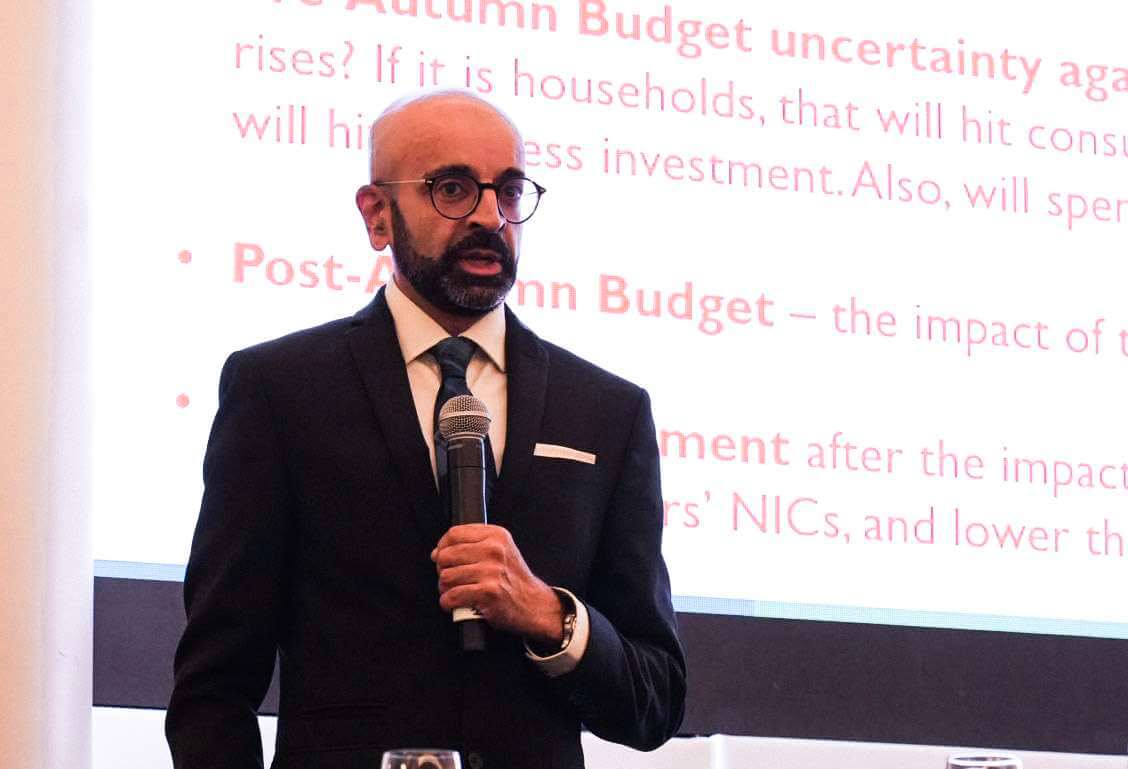
The UK housing market looks set for another challenging year, but the Construction Products Association (CPA) is forecasting modest growth in both newbuild and repair, maintenance and improvement (RMI) activity through 2026, albeit from an extremely low base. Speaking at the Timber Development UK Global Market Conference, Professor Noble Francis, Economics Director at the CPA, gave an in-depth overview of the economy and the outlook for construction, with housing at the centre of his presentation due to its significant impact on the timber sector.
“The economy is muddling through,” he told delegates. “We’re expecting GDP growth of 1.3% this year, rising slightly to 1.5% next year.” Noble described the forecast recovery as fragile, shaped by high interest rates, fragile consumer confidence, and ongoing uncertainty ahead of the autumn budget. “We know there are going to be tax rises, but we don’t know where. If [the taxes] hit businesses, it will hurt investment. If they hit consumers, it will damage confidence.”
Despite this uncertainty, the CPA expects housing outputs to improve next year, though from a low base. “For 2026, we’re anticipating public and private housing rising 4% in volume,” he said. “That growth will be heavily skewed towards the larger housing associations and the major housebuilders.” Smaller firms, he warned, would continue to face pressures from planning delays, extra regulatory costs and limited access to finance.
Noble said the first signs of improvement in the wider economy should start to emerge in the second half of 2026, but progress will be uneven. “High-rise developments, especially in London, will still face delays of six to nine months at Gateway 2 and another three to four months at Gateway 3 under the Building Safety Regulator,” he explained. “Investors are hesitant, and developers are holding back new applications until approval times improve.”
Public sector housing is expected to grow by around 4% in 2026, supported by the £39 billion Affordable Homes Programme, though Noble notes that “over half of that funding is back-end loaded into the next spending review period.” Even with the new framework in place, he said housing associations remain focused on maintaining existing stock rather than starting new developments. “Their priorities are basic living conditions, decarbonisation, and fire safety remediation,” he said. “That will continue to drive work on the existing housing stock rather than newbuild.”
Private housing RMI is forecast to rise by 2% next year, with growth “highly dependent on when homeowners feel confident enough to spend”. After a year dominated by caution and a flat economy, Noble said he believes confidence could begin to return in the spring. “There are households that have the finance,” he said. “The problem is uncertainty. Many are delaying even small discretionary projects, never mind larger ones. The recovery depends entirely on when people feel comfortable spending again.”
Energy-related home improvements remain a rare bright spot. “Areas like solar PV and heat pumps are doing well because they’re subsidised,” he said, “but these are small parts of the overall market.”
Noble also highlighted the pressures facing smaller housebuilders. “Planning is easier only if you appeal,” he said. “But on top of that you’ve got nutrient neutrality, water restrictions, and higher National Insurance costs. The major housebuilders can spread those costs across thousands of units, but the SMEs can’t.” With the Future Homes Standard and the new Building Safety Levy also both due to add costs in 2026, he warned that viability will remain a major constraint.
Although he foresees a gradual recovery in both housing and RMI, Noble noted that the government’s 300,000-homes-a-year target remains far out of reach. “To hit 1.5 million homes in five years, the final year would need to see 400,000 homes built,” he said. “That has never happened. Our forecast suggests the government will miss its target by about 30%, and even that figure may be optimistic.”
Labour shortages add another layer of risk, he noted. “Apprenticeship dropout rates are high, and since 2019, we’ve lost 280,000 skilled tradespeople,” Noble warned. “You can’t just replace that experience overnight.”
Despite these obstacles, his message ended on a cautiously positive note. “We expect slow recovery in housebuilding and RMI,” he concluded. “It’s still difficult and uncertain, but in the medium term there are real opportunities, particularly for those partnering with major housebuilders and housing associations, and in the energy efficiency and refurbishment markets.”
You can read the slides from the CPA presentation online here.


