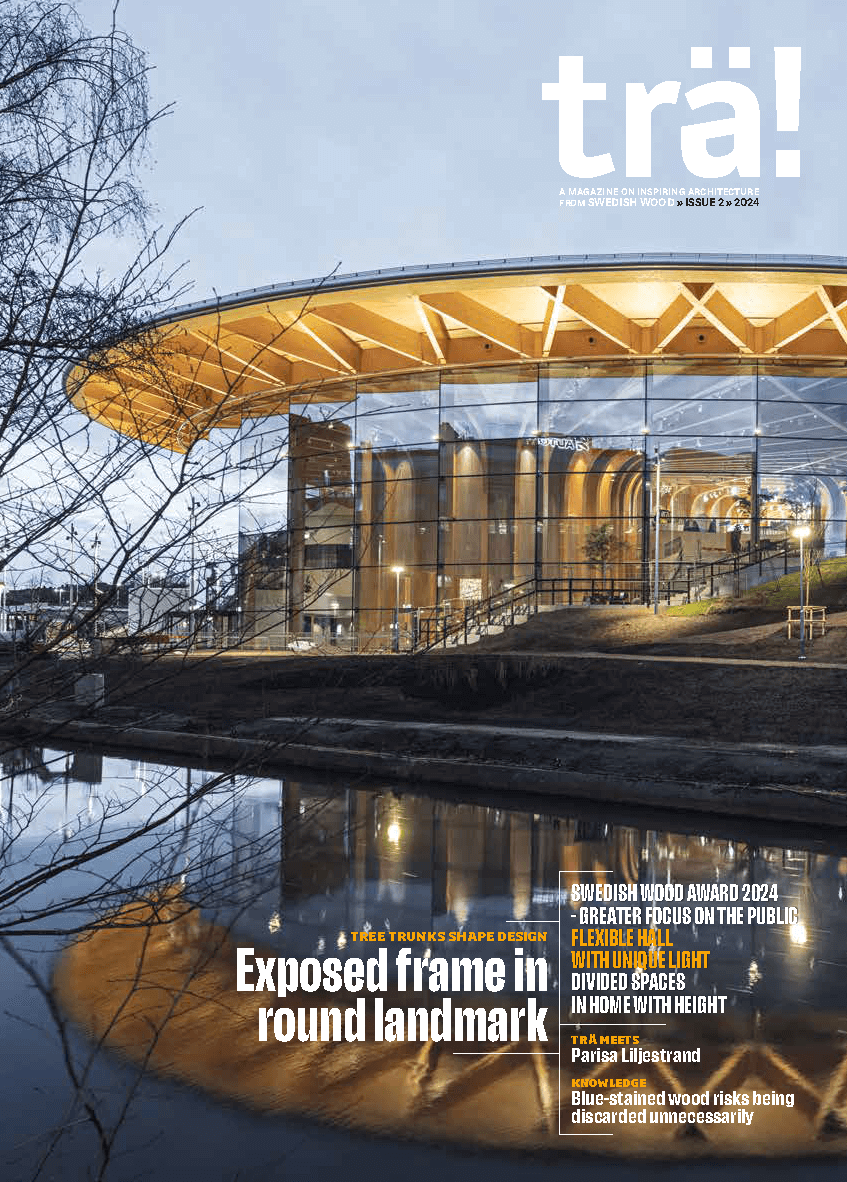
Trä! Issue 2 | 2024
Date Published
Document Type
Category
Theme
Author
Value the climate benefit of the forest industry
Early summer is finally here, with light evenings, singing birds and budding greenery. But it is not just nature that is boasting green shoots. The Riksbank’s
long-awaited cut to the key interest rate gives hope of a boost to housing construction. This is reflected in optimism about the future among Sweden’s sawmills. Over the past year, the industry has struggled with profitability due to rising costs, but hopefully we are now seeing a much-needed shift.
On the other hand, the Swedish National Board of Housing, Building and Planning’s proposal for limits on the climate impact of buildings, which has been out
for consultation this spring, does not inspire hope about housebuilding. It is a step in the right direction, not least because the construction and real estate sector is responsible for a large part of Sweden’s total greenhouse gas emissions. Many, including myself, think that introducing limit values is a good idea. But unfortunately, the proposal is insufficient to drive progress towards a lower carbon footprint. It is already possible to build in both wood and concrete with a lower climate impact than the proposed limit values for 2025. The proposal will thus be an empty exercise and not at all the political action needed to force change on construction projects with a high climate impact.
We need political action not just in Sweden, but also in the EU, to meet the climate challenge and give hope to future generations. The European Parliament elections are coming up, and a new Commission will then be appointed. The goal is for the EU to be climate-neutral by 2050, which requires a policy that values the total climate benefit from the forest industry – in terms of both the growing forest and the products made from forest raw materials that are able to replace fossil materials. A recent study on substitution potential and climate impact in the EU forest value chain, conducted by AFRY on behalf of the Wallenberg Foundations’ holding company FAM, shows that increasing the substitution of fossil materials with fibre-based raw materials is crucial to reducing EU emissions. The study finds that the greatest climate benefits are achieved by replacing fossil-dependent building materials with wooden buildings and substituting plastic packaging with fibre-based packaging materials.
Read the Swedish Forest Industries Federation’s election survey to find out more about the issues that some of Sweden’s European Parliament candidates want to pursue over the next term.
Contributors:
About the editor