Dimension Timber
Product Type
Subcategory


Dimension timber is a term used to describe sections of wood cut from logs and sold as sawn and surfaced wood products. The timber is cut into a variety of standard ‘dimension’ (lengths, thicknesses and widths), and is used in both structural and non-structural construction applications.
Some of the most common types of dimension timber include:
- Structural Softwood
- Structural Hardwood
- Non-structural Softwood
- CLS and Stud work
- Exterior and Landscaping timber
- BS 5534 Tile Battens
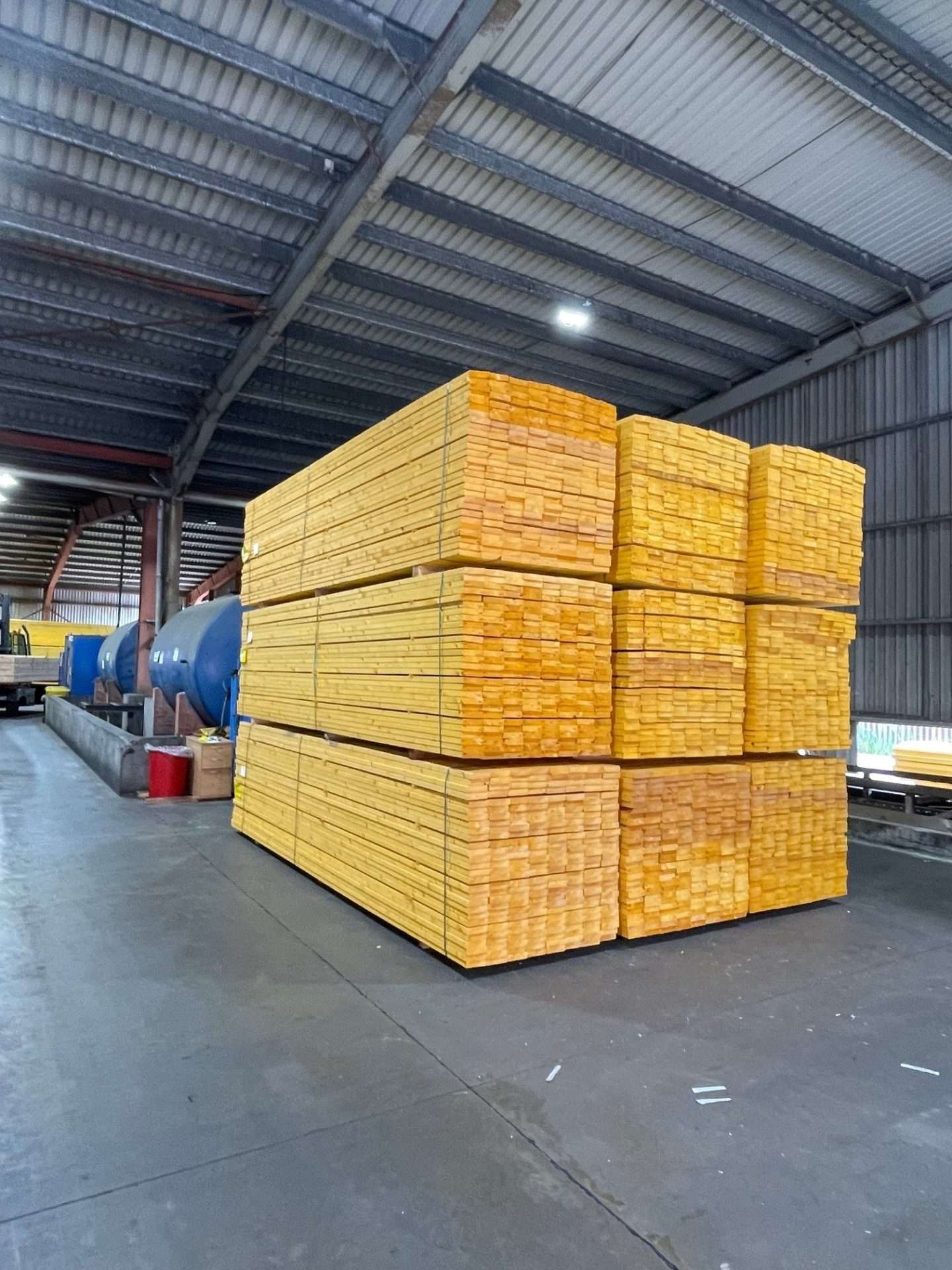
Structural softwoods are used as part of the timber frame of a building, to form the load-bearing structure this is why they are often described as Carcassing. Structural softwoods are also used to form the roof, internal walls or floors within other forms of construction such as brick and block or steel frame.
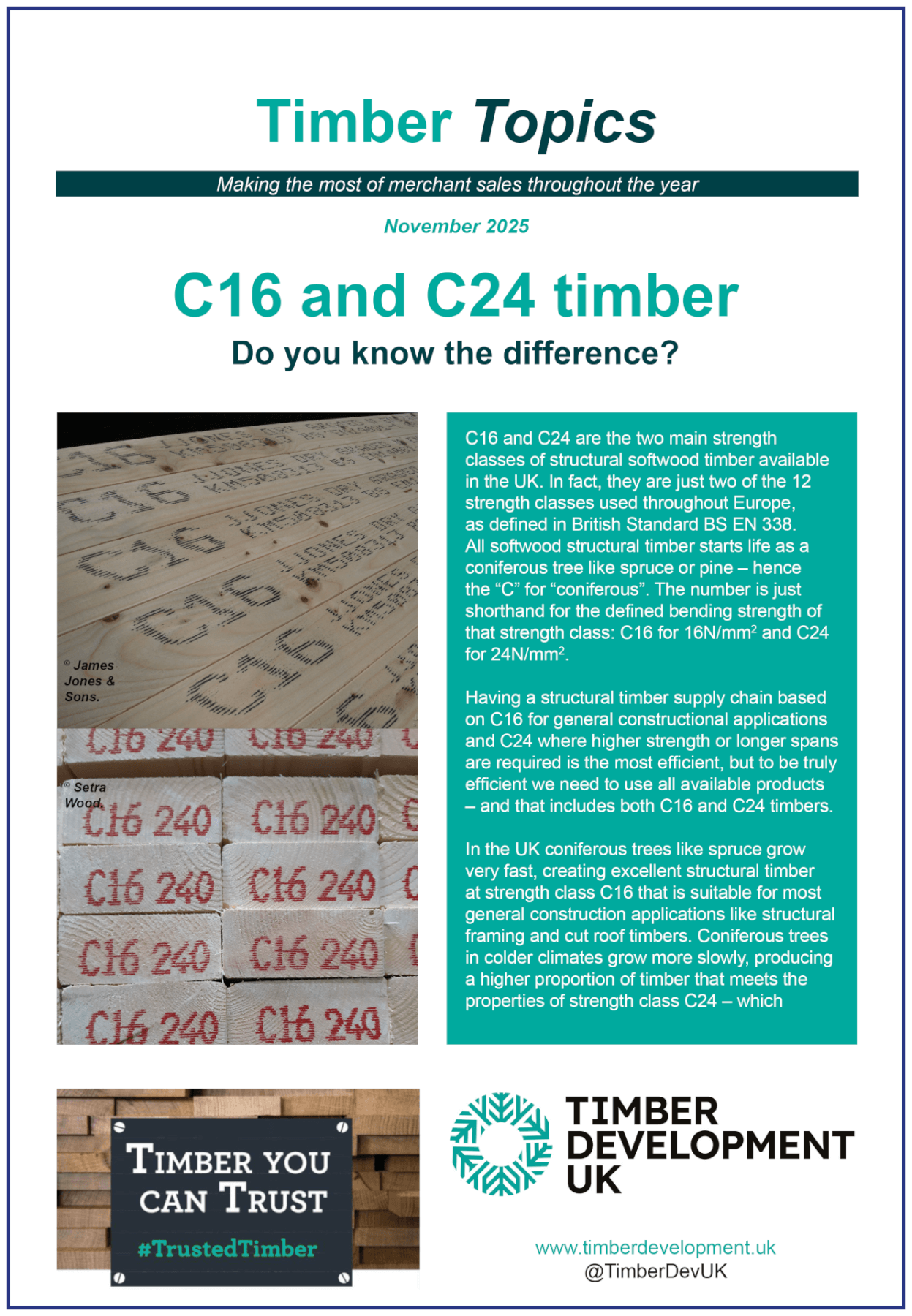
Structural softwoods in the UK are normally British or European Whitewood (Spruce), strength graded to C16 for general structural applications in floors, walls and roofs, and C24 for longer span or greater load applications. Both C16 and C24 strength-graded timbers are used widely in the construction industry and are considered strong and durable. C24 timber achieves a higher strength performance. (See Strength Grading below.)
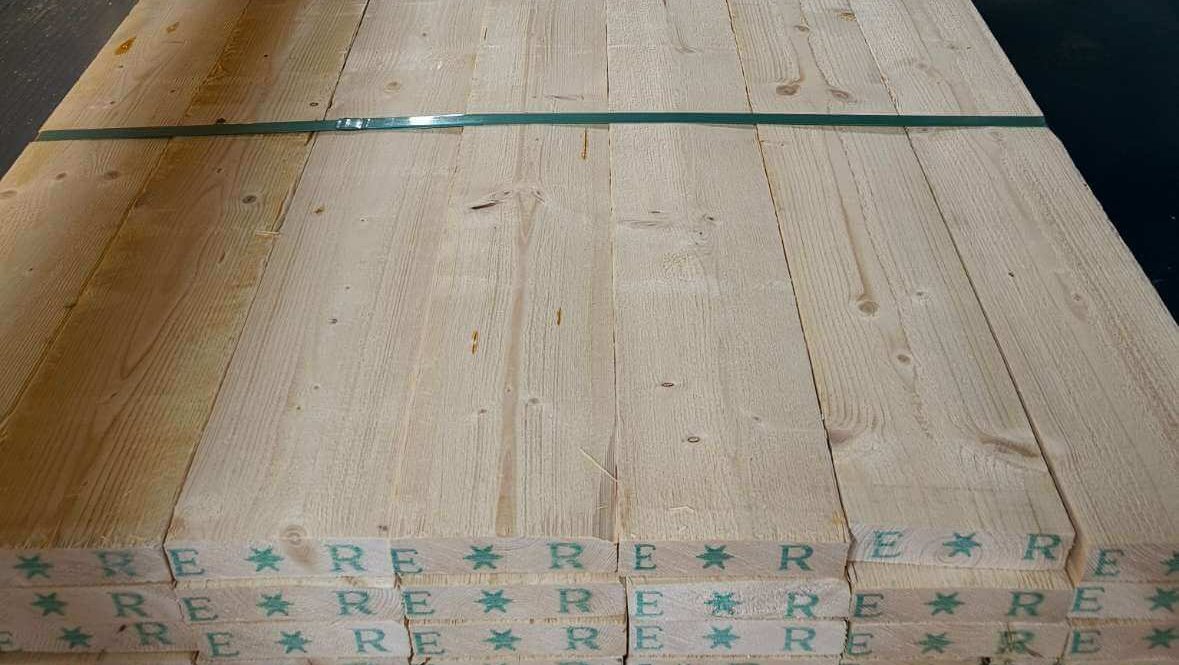
Modern structural softwoods are supplied kiln dried and machined, which means consistent sizes and reduced splinters for the safety of construction workers. This is also why edges are ‘eased’.
They can be supplied untreated or preservative treated, and it is important to get the Use Class treatment level right for the intended end use (see Preservative Treatments below). Most structural softwoods are only suppled treated to Use Class 2, and so are suitable only for applications within the building envelope.
- Common nominal section sizes for structural softwoods are: 47x50mm, 75mm, 100mm, 125mm, 150mm, 175mm, 200mm, 225mm and 250mm / 75x150mm, 175mm, 200mm and 225mm / 100mm x200mm. Many other sizes are also available to order.
- Lengths increase in increments of 0.3m, from 2.4m up to 4.8m.
- Longer lengths can be supplied on request from TDUK Suppliers.
Typical uses for structural softwoods include first fix materials such as floor joists, cut roof timbers wall plates and framing, and TR26 Roof Truss Material. Other softwood species especially those from UK forests, such as Douglas Fir, Larch and Hemlock are available as structural sections by special order but it is important to check they are being supplied at the appropriate moisture content and meet the required strength class.
Structural hardwoods are best ordered from specialist suppliers who can give reputable advice, and always check the architects’ or builder’s specification before making a purchase to clarify the end use.
Hardwood beams and structural timbers offer greater strength and stiffness, and are available in longer lengths and larger sections than their softwood equivalents.
BS EN 14081 applies to all woods intended for structural purposes. Hardwood strength classes for particular species are set out in BS EN 1912 as most are visually strength graded. Strength classes for Hardwoods range from D30-D70. (See Strength Grading below.)
Some specialist suppliers stock sections of various hardwood species cutting them as needed. This means Structural hardwoods and hardwood beams are produced to specification and generally require advance notice.
Potential sources of structural Hardwoods are:
- UK and European forests providing temperate hardwoods such as Oak, Beech and Ash
- West African forests providing tropical hardwoods such as Sapele, Utile and Iroko North American forests supplying temperate hardwood such as American White and Red Oak, Ash and Tulipwood or Poplar.
- Far Eastern, Central and South American forests supplying tropical hardwood such as Greenheart, Red Grandis, Cumaru, Massaranduba, Ekki, Meranti and Shorea species
Most structural hardwoods are durable and need no further preservative treatment. However, if they are being used in water (freshwater/marine environments), species choice is critical to the working life of the timber in use as very few are suitable for such applications.
Non-structural softwoods are dimensioned timber products used for construction projects, but not in load-bearing applications because they have not been subject to a strength grading process. These can include framing, battens, strutting and noggings.
The most common form of timber for studding and creating internal partitions is CLS, supplied regularised (surfaced) with eased edges.
It is usually made from kiln-dried Whitewood (Spruce) and strength-graded to C16. Ungraded CLS timber can only be used for non-load-bearing applications
- CLS is produced in a very specific set of finished sizes, the most common of which are 38x63mm/38x89mm and 38x140mm
- Lengths available range from 2.4m to 4.8m, with 5.4m and 6.0m available to order
Scant timber, which is more common in the north-west of England, is slightly larger in finished sizes than CLS. This timber is surfaced (regularised) and corners are square not rounded.
- Scant is usually made from kiln-dried whitewood (Spruce) and strength-graded to C16. Again, ungraded Scant timber can only be used in non-load-bearing applications.
- The most common size for Scant is 42x69mm.
- Lengths available range from 2.4 to 4.8m, usually in 0.6m increments.
Structural softwood such as C16 or C24 can be used outside of the building envelope but generally does not have sufficient natural durability to meet the required desired service life for exterior construction applications particularly those in ground contact. TDUK and our partners at WPA recommend that any structural softwoods in ground contact or used externally in safety critical, usually load bearing situations are treated for Use Class 4 applications. Examples would be deck Joists and raised deck structural framing, deck posts and steps, landscaping timbers in ground contact or providing a restraining soil function.
Permeable species such as European Redwood (Pine) are available now in C16 and C24 for exterior applications, such species take preservative treatment well and so are ideally suited for structural exterior Use Class 4 applications. Resistant species such as the Spruce used for most construction applications will need additional processing such as incision to meet the penetration requirements for Use Class 4 applications.
Tile battens, or roof battens, are a key element of slated and tiled roofs. They are the long timbers of small cross-section that span across rafters and provide the fixing point for roofing materials. They are a safety-critical product and must be able to carry the weight of the roof and tiles, as well as the forces caused by wind and snow. They may also provide a foothold for the workers installing the roof covering.
This safety-critical product must be a minimum of 25mm thick and, to protect the safety of roofers, must always be graded and marked to meet the specific requirements of the national standard BS 5534.
Speak to your TDUK Supplier for detailed information, or see our Timber Knowledge Sheet on Roof Battens
Due diligence on sustainable sourcing is essential – most European-produced softwoods and hardwoods are available with either FSC or PEFC certification, while FLEGT-licensed timber is also available from Indonesia. North American species less commonly have FSC and PEFC certification, but do come with a life-cycle analysis which may be useful.
All structural timber is strength graded to BS EN 14081 — the UK Designated (EU Harmonised) standard. This means all structural timber must be UKCA or CE marked, including its strength class, to confirm it is in compliance with this standard. The higher the number, the higher the strength Class.
- Whitewood and Redwood (Spruce & Pine) merchant grades are normally C16 and C24. Softwood strength classes can range from C14 to C30 by special order.
- Timber marked as TR26 is mostly used to manufacture roof trusses.
- Other graded softwoods include Douglas Fir (C14-C24), Larch (C16-C24) and Western Red Cedar (C14-18).
Machine grading marks
Machine-graded softwoods are graded to BS EN 14081 – part 2. The letter M indicates the timber has been machine graded directly to the marked strength class.
Visual grading marks
Visually strength-graded softwoods are graded to BS EN 4978.
- GS indicates suitability for General Structural purposes
- SS indicates suitability for Special Structural purposes.
- For most species GS is strength Class C16 and SS is C24.
Hardwoods are visually-graded to BS EN 5756 for temperate species and BS EN 16737 for tropical species with strength grades:
- THA and THB: for Heavy Structural Temperate Hardwoods in large-sections >100mm thick.
- TH1 and TH2 for General Structural Temperate Hardwoods in small sections <100mm thick.
- STH for Structural Tropical Hardwoods.
Once graded and marked as above, species are allocated to Hardwood Strength Classes between D30-D70 based on the assignments in BS EN 1912.
Specific levels of preservative treatment are needed for timbers in different situations, to make sure the timber is suitable for its intended end use. Different applications have been allocated ‘Use Classes’, which are defined by British and European Standards and provide a guide to the risk of decay and insect attack to timber components, depending upon their end use. The higher the Use Class, the higher the level of preservative protection required for the timber to be suitable.
The different Use Classes are:
- Use Class 2 treated: for Structural framing timbers including Carcassing, CLS and Scant used within the building envelope when treatment is required and when they are used above the ground or damp-proof course, in covered situations: tiling battens, internal construction timbers such as framing timbers, roof timbers, internal joists, and sole plates
- Use Class 3 treated: for timbers used above the ground outside. Applications include deck boards, fence rails and boards, cladding (including battens) and roof finishing timbers such as fascias, barge boards and soffits
- Use Class 4 treated: applications include any timbers in ground contact or used externally in safety critical usually load bearing situations. These include timber that is in contact with or buried into the ground providing external structure support, such as decking joists, fence and deck posts, external and garden structures or retaining walls
Reaction to Fire classifications of building materials including Structural softwoods and hardwoods can be found in a product’s Declaration of Performance (DoP). Most wood products are classified as Euroclass D without the need for further testing. This can be upgraded to Class C or B with an appropriate factory-applied, quality-assured flame retardant treatment. If your customer requests structural framing to be flame-retardant treated, contact your TDUK supplier for advice. At the time of writing, UK legislation does not require structural framing timbers including Carcassing, Scant or CLS to be treated with flame-retardant treatments.
Checking the product’s DoP should be part of your due diligence before advising customers or accepting a sale. Always make sure you are selling a fit-for-purpose product.
TDUK, in partnership with the Wood Protection Association, has produced a set of information leaflets to help with all the above. Visit the ‘Fire Treatment’ resources section on TDUK’s Bookshop.
The Structural Timber Association and the Wood Protection Association have developed a standard for a factory-applied, quality-controlled application of flame-retardant treatment to carcassing, called FR-BUILD.
FR-BUILD accredited carcassing is a requirement on all STA member building sites. Currently, FR-BUILD scheme carcassing is only available through timber-frame housing producers.
FR Build FR treatments are specifically intended to protect timber framing during the construction phase and are not designed to provide protection throughout the life of the building. At the time of writing, UK legislation does not require structural framing timbers including Carcassing, Scant or CLS to be treated with flame-retardant treatments.
The FR BUILD scheme described above is a voluntarily initiative by our sector to maintain site safety during construction.