Timber Connections
Product Type
Subcategory


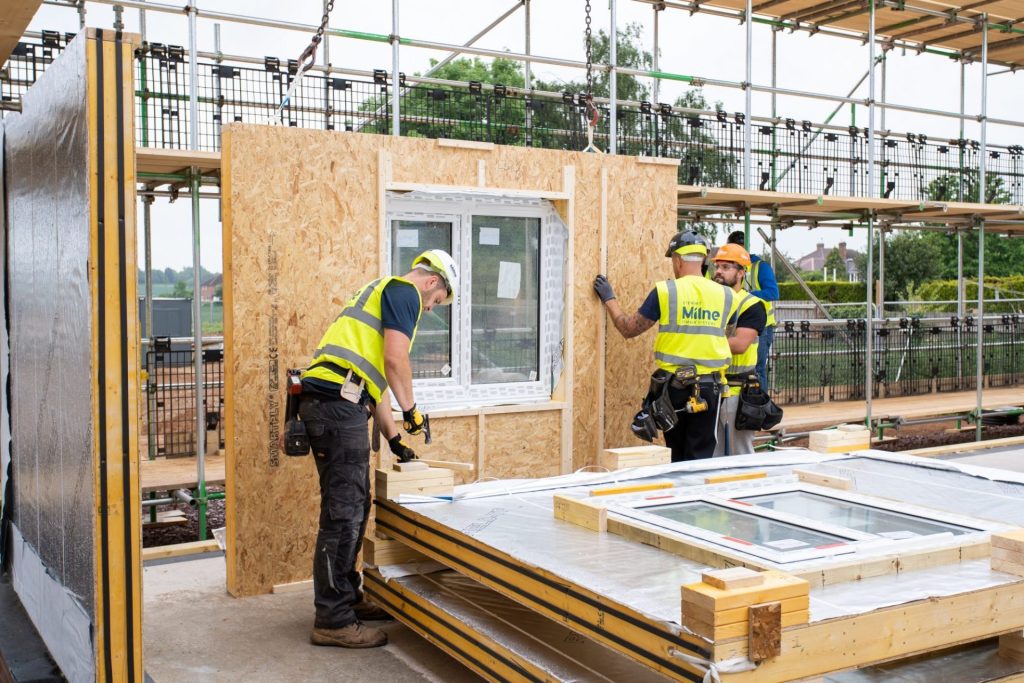
Traditional timber to timber joints have demonstrated performance over hundreds of years and can be proven by calculation to meet the requirements within building design codes such as those used in the UK. However the need for accuracy means their construction takes time and skill. This has led to the development of specialist connections based on other materials, primarily steel which reduce the time on site increasing the efficiency of timber construction.
Nails can be smooth or improved for greater withdrawal resistance which usually means square twisted for use with hangers and other light gauge steelwork or threaded such as ring shanked which are popular for using in floors. All of these types of nails will be available in variety of finishes such as galvanised, sherardized or made from stainless steel.
Screws have improved axial properties due the presence of a thread and are usually in the range 2.4mm to 24mm outer thread diameter. Traditionally the ultimate tensile strength of steel used for wood screws was taken as 540 N/mm2 but some now claim a higher performance. Coach screws have a hexagonal or square head tightened with a spanner and are often used to connect steel plates to timber. Screws will be available in variety of finishes such as galvanised, sherardized or made from stainless steel.
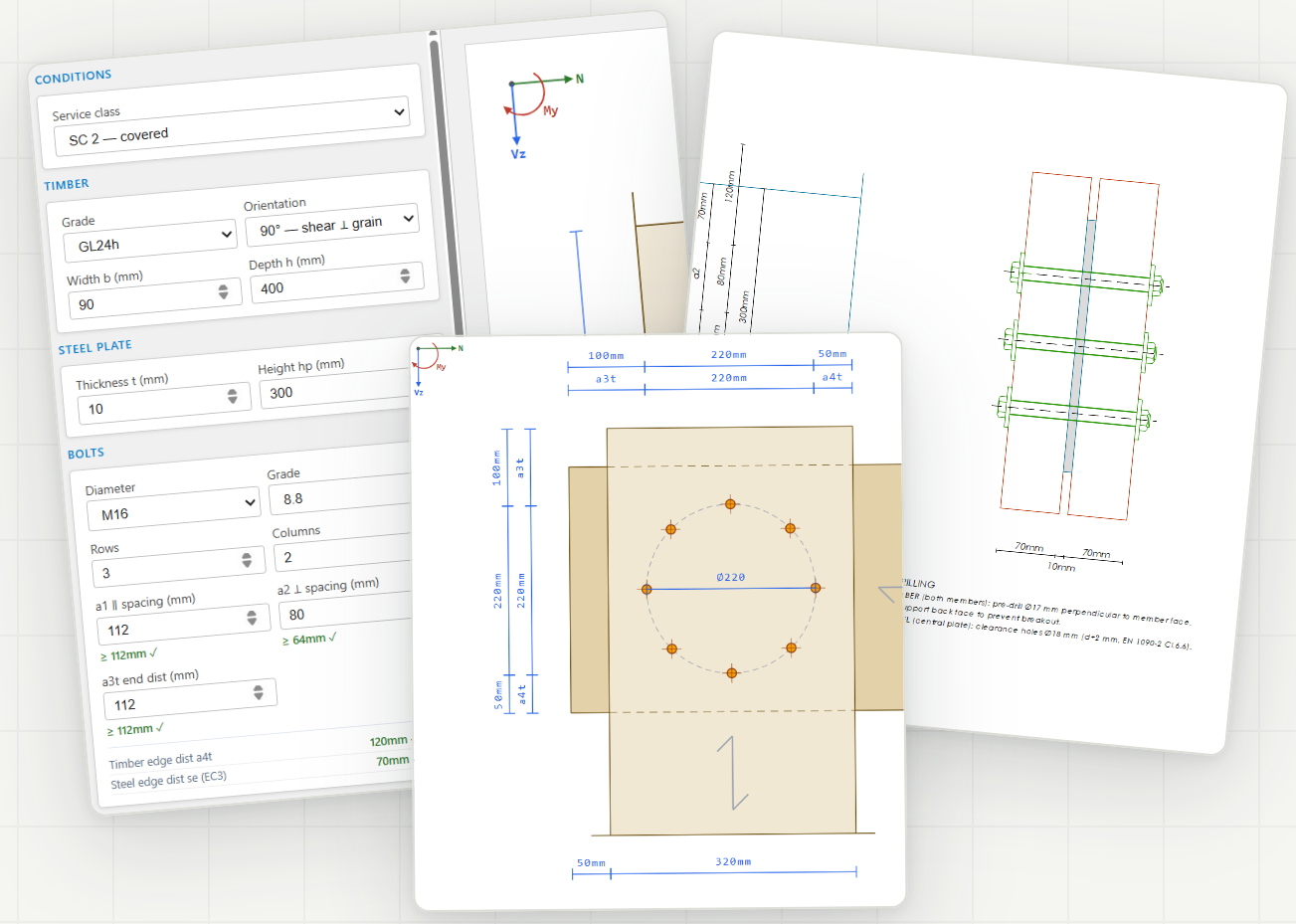
Blots should be in the range from 6mm to 30mm diameter and usually of a minimum assumed strength of 400 N/mm2 but other grades of steel may be specified. Bolted connections should always be used with steel washers below the nut and bolt head when tightened directly on to timber with a minimum external diameter or side length of 3d (3 x the diameter) and 0.3d in thickness.
Bolted timber joints are often formed using Split ring, Shear plate or Tooth plate connectors to improve performance.
Threaded or smooth rod connections are often neater than bolted connections with similar performance but cannot used where axial loading is required.
All of the above are dowel type fasteners as identified in Eurocode 5, and are covered within the national standard BS EN 14592:2022 Timber structures. Dowel-type fasteners. Requirements Hangers and supports.
These fastenings are manufactured to standard sizes with specific performance criteria declared within the suppliers literature. They are usually classified as either two dimensional 2D or three dimensional 3D plates.
Two dimensional types are further subdivided into: 2D Nail plates which are most commonly used for in-plane structural joints such as those at trussed rafter node points. Or 2D Punched metal plates with pre-formed holes through which improved nails are fixed in a factory or on site. The size and thickness of the plate along with the geometry of the nails and holes will determine the performance of the plate and joint it is used to form.
Three dimensional types are manufactured by bending steel plate into various shapes to form joist hangers, truss clips, brace anchors and restraint straps. Test values, performance criteria and manufacturing quality are set out in ETAG 015 (European Technical Approval Guideline) – Three Dimensional Nailing Plates
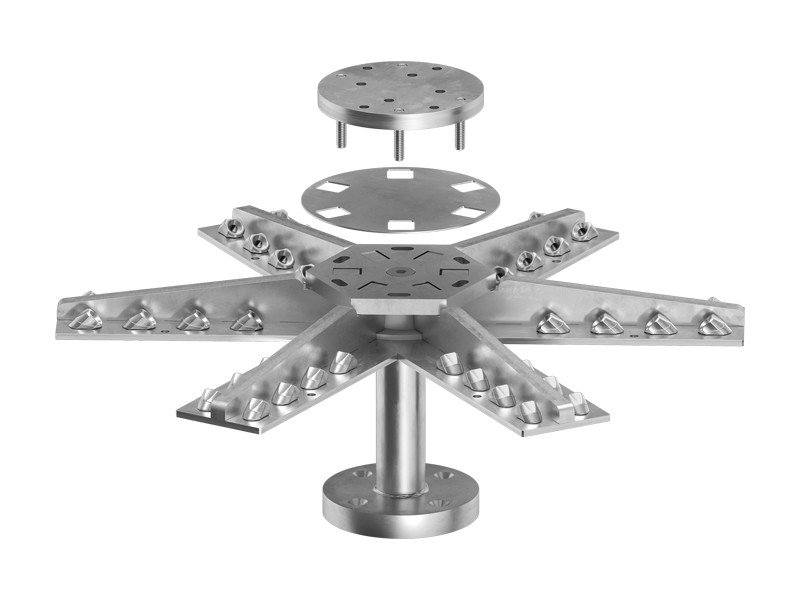
The development of engineered wood products especially mass timber has encouraged the development of customised timber connections which effectively transfer the required loads between the timber elements and subassemblies. Each manufacturer will produce its own range of custom connections and publish the performance criteria in their technical literature.
Load-bearing glued joints in timber construction can only be made from adhesives tested according to BS EN 302 – Adhesives for loadbearing timber structures. These are predominately curable synthetic resin glues such as Phenol, Urea, Melamine and Epoxy.
Structural glued joints generally have the advantage of being stiffer, of better visual appearance and more stable in fire situations than the mechanical connections above. However, they require stringent quality control during manufacture and their eventual performance is impacted by choice of species and moisture content of the components at time of assembly.