TDUK Trade Note: Transition of Fire Door Testing Away from the National Standard BS.476 Series

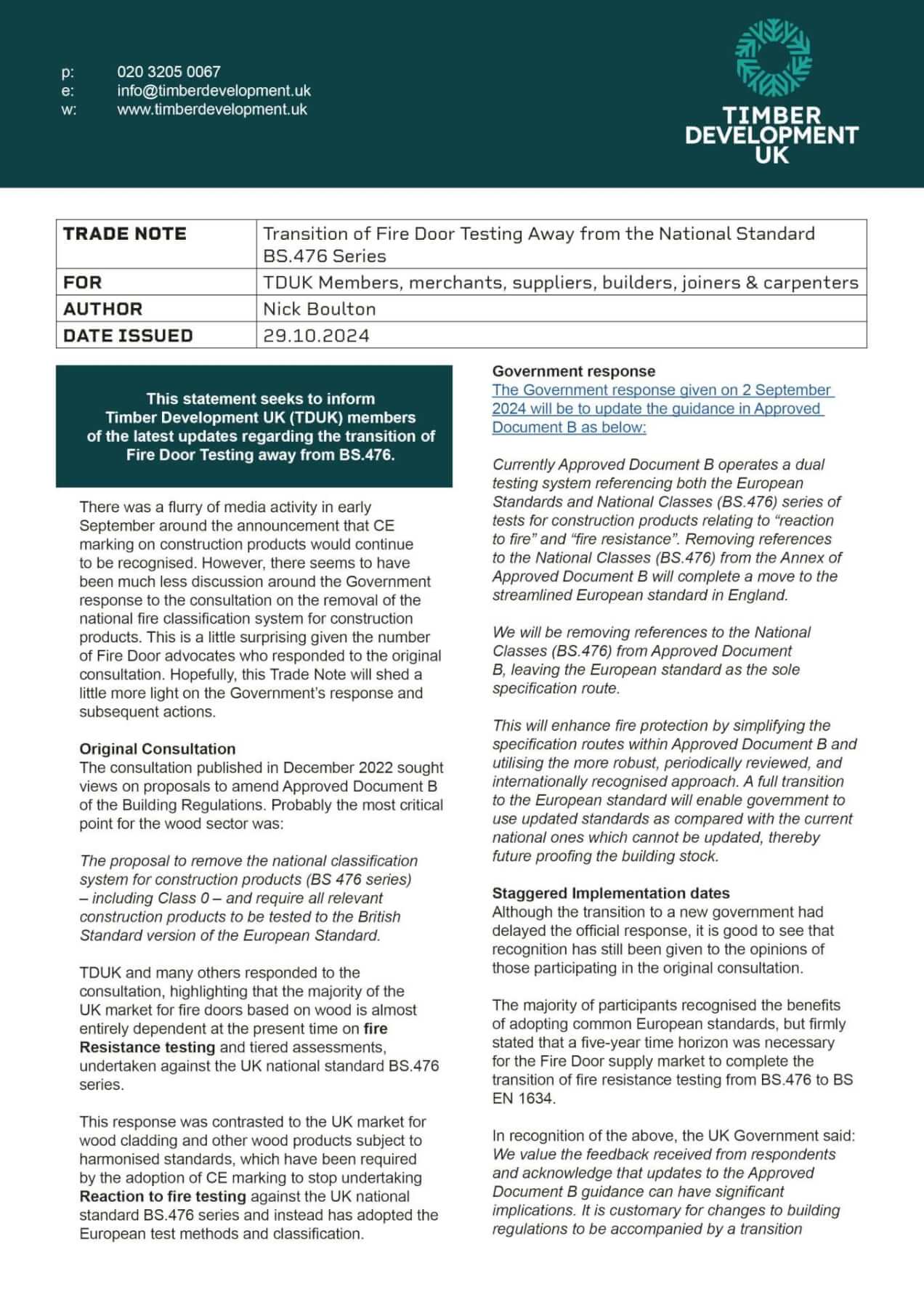
TDUK Trade Note: Transition of Fire Door Testing Away from the National Standard BS.476 Series
||,
This statement seeks to inform Timber Development UK (TDUK) members of the latest updates regarding the transition of Fire Door Testing away from BS.476.
continue reading
Timber Topics October 2024 | Fire Safety
||,
Do you know the facts about flame retardant treatments and wood products? Merchants play an important role in promoting fire safety, and in ensuring the products you sell are fit for purpose. Here, we explain some of the key terminology and what you need to know about the products you...
continue reading
Fire-resisting doorsets
Fire-Resisting Doorsets
||
Ideal for creating practical outdoor spaces, timber decking provides an excellent garden landscaping option when it is correctly specified, designed, installed, and maintained.
continue reading
Fire Retardant Treatments
||
As timber has a high structural strength and slow charring rate, its general behaviour in a fire is predictable. Fire retardant treatments slow the rate at which fire develops, giving more time for a safe escape.
continue reading
fire protection terms
Understanding Fire Protection Terms – Classification without further testing (CWFT)
||
In some cases, it is possible to classify untreated wood-based products without further testing as long as these products meet the requirements set out in the relevant harmonised technical specification.
continue reading
Flame Retardant Treatments
Flame Retardant Treatments for Timber – An Overview
||
Flame Retardant (FR) chemical treatments for timber work by reducing its ignitability, slowing down the surface spread of flame and, as a result, reducing the heat released. This allows more time for escape in a fire situation.
continue reading
Reaction to fire and Fire resistance
||
Reaction to fire classifications are completely different to fire resistance ratings yet the two terms are often misunderstood and taken to mean the same thing. This is not the case. This publication aims to set out the important differences. Understanding fire performance terminology starts with understanding the stages in the...
continue reading
Assuring Quality – The Flame Retardant Treated Wood Supply Chain
||
Where a flame retardant (FR) is added in the factory during the manufacturing process for MDF, OSB or plywood then that manufacturing process should be subject to factory production control (accredited by a notified body). The product should carry the CE mark and be accompanied by a valid Declaration of...
continue reading
Understanding Fire Protection Terms – Combustibility
||
There are four recognised stages in the development of any fire: Ignition, Spread and Growth, Flash point into a fully developed fire and Eventual Decay. During the early stages, when a fire is still becoming established, the important factors are: Ignitability, Spread of Flame, Smoke Production and Flaming droplets.
continue reading
Understanding Fire Protection Terms – Service Environment
||
It is vital that any flame retardant treatment incorporated into a building provides long-term, predictable performance backed by independent verification. Before specifying enhancement using a flame retardant, two specification fundamentals must be established: What reaction to fire performance is required? and What is the service environment?.
continue reading