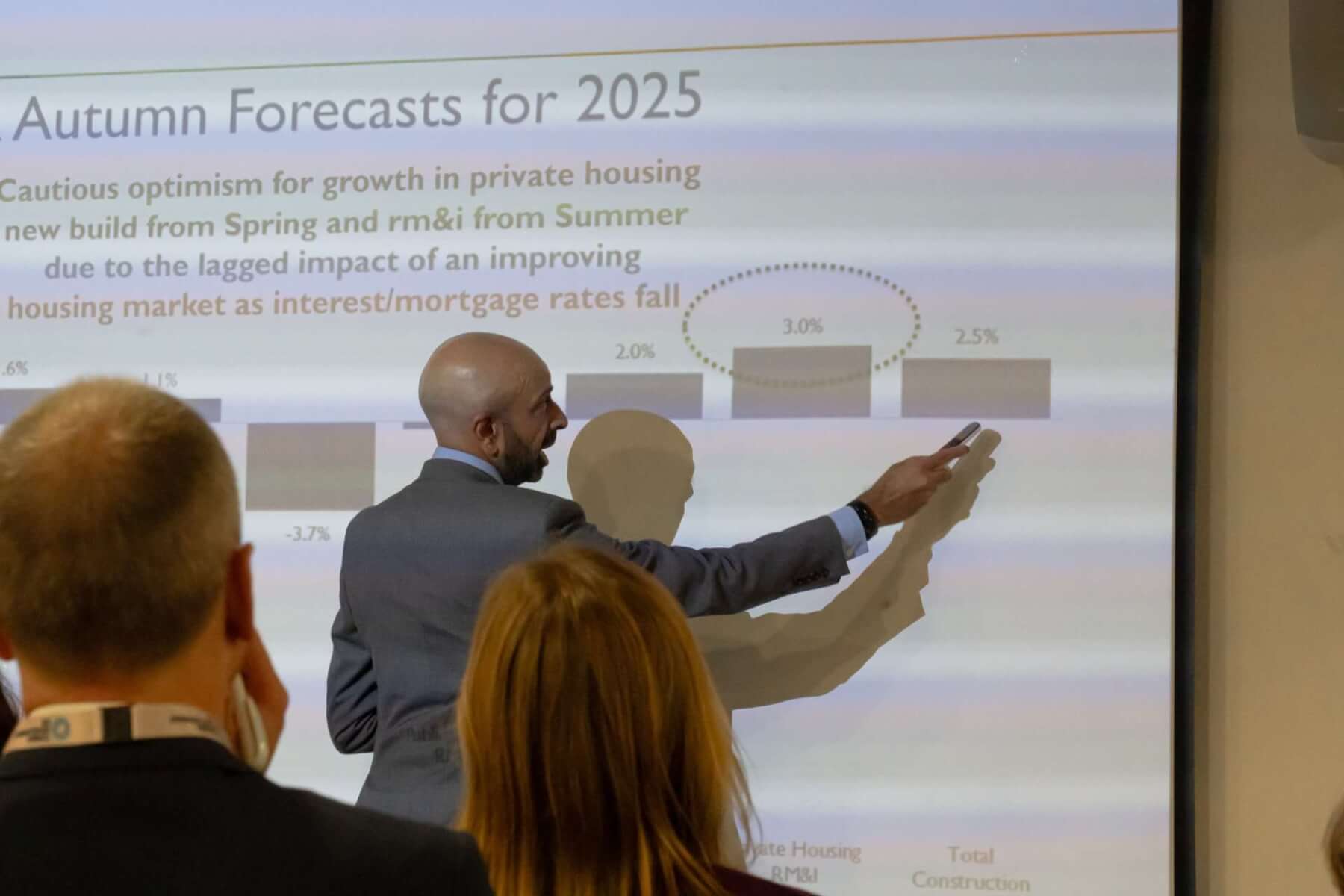
Concluding the TDUK Global Market Conference, Professor Noble Francis from the Construction Products Association (CPA) gave delegates an update on the outlook for the UK construction sector, highlighting the challenges and opportunities that lie ahead, but suggesting there was room for cautious optimism for the coming years.
The recent CPA forecast projects GDP growth of 1.1% for 2024, 1.7% for 2025, and 2.3% for 2026, indicating a gradual recovery for the UK economy.
“It’s been a challenging few years, to say the least, if you’re feeding into new housebuilding and private housing repair, maintenance and improvement (RMI),” Noble began, “but there are reasons for optimism next year and the year after, though some key risks as well.”
He noted the impact the recent Autumn Budget has had on the forecasts, especially for construction, with a boost to capital investment and work on schools, affordable homes and the NHS estate all being positive, but noted that increases to the National Living Wage and National Insurance (NI) contributions, and lower NI thresholds will be very difficult for some firms to absorb.
The CPA expects the construction sector to finish 2024 2.9% down, with the biggest falls being -10% in public housing and -9% in private housing. That decline is on the back of a -14% fall in private housing last year, highlighting just how difficult the past few years have been.
“Things are starting to improve in the private housing market,” Noble said. “You’re seeing improving mortgage approvals and property transactions, but the major housebuilders are focused on completing existing developments, not starting new developments, until they see a sustained pick up over the course of the rest of this year and into next.”
Noble believes that the government’s pledge to reform the planning system will be positive but noted that this will take time to change in practical terms, especially with an ongoing lack of planners within local authorities.
He also said that growing housing market transactions will inevitably lead to an improvement in the number of home improvement markets, but that, again, there tends to be a six-month lag between home moves and home improvements, so he doesn’t expect private housing RMI to improve significantly until Spring/Summer 2025.
“Next year, we’re expecting total construction output to rise 2.5% in volume terms; mainly driven by private housing, which we’re expecting to rise 8%. While it’s not as much growth as the government would like, given their targets for house building, it’s growth from a low point, and it is a significant improvement,” Noble continued. “So we’re looking at that sustained recovery coming through next year, with growth expected in all construction sectors except commercial and industrial.”
Are housebuilding targets achievable?
Noble then turned to the government’s target of building 1.5 million new homes in the next five years, which he said was, “quite simply not going to happen”, as it would require an average of 300,000 homes to be built each year, when that figure is expected to only reach 180,000 this year. Instead, he believes 1.1 million is more achievable, though optimistic, and would still be a 30% rise from current housebuilding levels.
Short- and long-term risks
Noble highlighted materials inflation and construction insolvencies as two particular risks to construction growth in the short term, as well as the continuing delays around the Building Safety Act.
There is currently a six-month delay in getting ‘higher risk’ projects signed off because of Gateway Two, due to a lack of capacity at the regulator and continuing uncertainty around the information that businesses need to provide. And while materials inflation has largely fallen since the spike seen in 2022 after Russia invaded Ukraine, Noble said that prices have started to rise again since the start of 2024 and remain 39% higher this year than they were in January 2020, before the pandemic.
One of the biggest risks, Noble said, was insolvencies. “Contractor insolvencies in the first half of the year were at their highest levels since the financial crisis, with 58% of those [being] specialist contractors. The big issues from ISG [and other large contractors] going under are due to the impacts on subcontractors; it exacerbates problems they already have. It also leads to project delays, cash flow issues for subcontractors, and issues around trade credit.”
Despite these ongoing concerns, Noble said there were potential opportunities in other areas of construction that he believes are worth considering. “It is worth thinking about some of those areas you don’t tend to feed into but which will experience very strong growth in demand.
“There is a lot of potential in commercial refurb and fit out, especially as the demand within commercial office space and retail space is for high-quality, high-end space. And there is an awful lot of office stock that is below EPC rated B, [which] building owners will have to refurb.
“There is also a critical energy efficiency retrofit to the existing housing stock. We have 17 million homes across the UK that are EPC rated C or below, and we will have to retrofit them.”
Ultimately, Noble said that the most important question is who is going to do the work as construction growth returns. “Government has a lot of intent, but what they will struggle with is delivery. So, if you as a sector can provide solutions, there is a great opportunity there.”