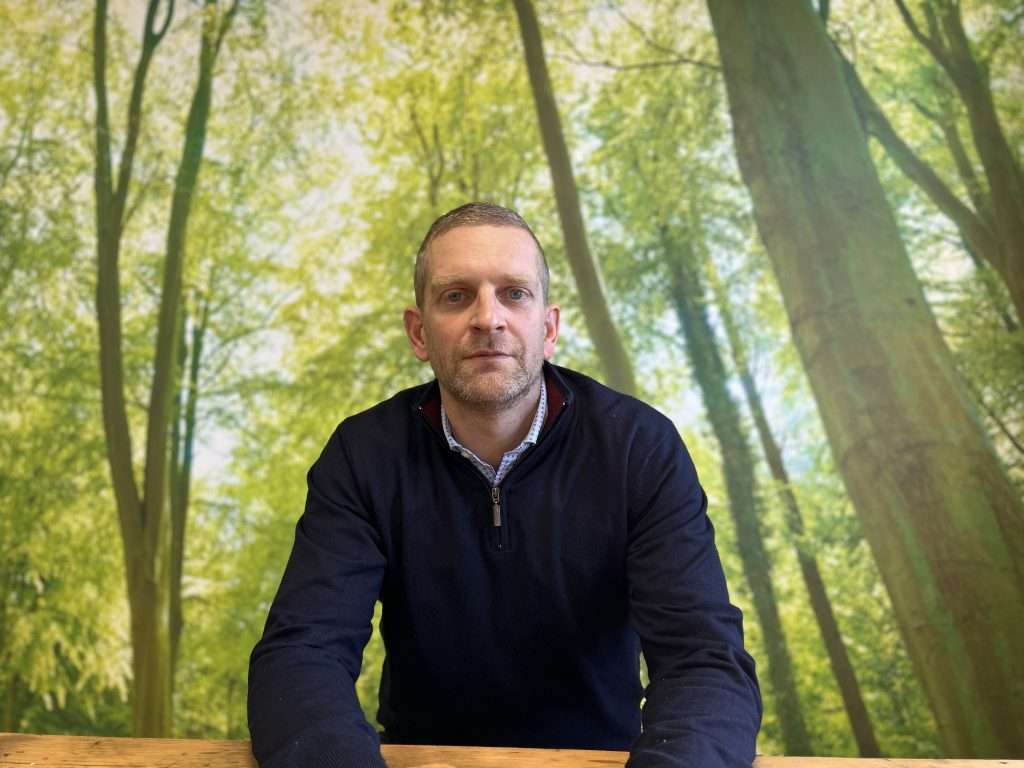
Mike Glennon, Joint Managing Director of Glennon Brothers, and Graham Blyth, Sales Director at James Jones & Sons brought an international perspective to the TDUK Global Market Conference, exploring the challenges and outlook for British and Irish sawmills. They highlighted the UK’s lack of timber production capacity and were among many speakers at the Conference concerned about the need to allocate additional resources to homegrown timber production to better manage the balance between supply and demand.
Graham began by acknowledging the lack of additional production capacity in the UK beyond the current levels of 3.2 to 3.3 million m3.
“The issue is, is there any additional production capacity at the moment? No, is the answer. I think the challenge will be how we proportion that capacity out to satisfy demands on competing specifications. When you’re relying on carcassing and on construction materials, it’s not very profitable and there’s a fragmented structure of pricing that really doesn’t make any sense at all. And other challenges; economic confidence, credit insurance, private equity, investment and ownership, all of these things filter into it. I’m actually quite positive about the opportunities for 2025 in an improving economic situation, but it’s a question of how quickly things improve.”
Mike gave an overview of the Irish economy, which he said has performed incredibly well in recent years compared to some others. Ireland is currently 12% forest cover, compared to the European average of 38%. The Republic of Ireland produces around one million m3 of timber, with only 450,000 used domestically. Northern Ireland and the Republic together produces around 1.4 to 1.5 million m3.
He continued: “We expect overall economic growth of around 2% GDP in 2024, and inflation has fallen this year, with an unemployment rate of only 4.2%, which means finding people in Ireland is an enormous challenge. So the success of the economy has brought its own round of challenges. The key driver for us will be housing starts. The housing requirement for the Irish market is 50,000 units per annum, and the housing shortage is the single biggest issue that will face the government as they face an election.”
Mike echoed Graham’s concerns over the future output of timber and the current low levels of tree planting to ensure continued supply availability. “There has been a curtailment in logs coming from Scotland to Ireland, and from an Irish perspective, we have the lowest level of tree planting in 77 years. We’ve only planted 1,600 hectares in 2023 when the government target was 8,000 hectares, and the climate change target is 23,000 hectares. So the Irish people are going to have to stump up millions of Euros because they’re not going to hit their greenhouse gas emission, which could be done if we planted more trees.
“The Irish government are coming out very strongly on building with wood, but haven’t been able to connect the dots that to build with wood you actually need to plant trees, and that’s a major issue. I’m not convinced [that] if we had the demand, we could find the logs.”
When asked whether it’s more important to build supply or demand, Mike urged delegates to build partnerships so that the whole supply chain works together to tackle these issues. “I believe the marketplace doesn’t understand that if the market picks up, that we won’t be able to ratchet up the volumes. We have to build partnerships [so] that we all work together going forward.”
Graham agreed with the sentiment. “The challenge is that for the available volumes, there are competing demands from different specifications. And price will influence that. British and Irish mills cannot produce a single range of specification for one sector; it has to produce a blend of everything.”
Promoting homegrown timber
Mike also acknowledged that the Irish government has invested in reports looking at forestry and timber sector opportunities, and is now looking at how to educate people to use more homegrown timber.
“I think there is a realisation that we need to educate people to use more timber. We’re probably starting from a better position than in the UK, because currently homegrown timber on the island of Ireland is probably two-thirds market share. So people are used to stocking homegrown timber right throughout the country and there isn’t this divide that you see in in the UK. There are very few provincial towns in Ireland where there isn’t homegrown timber being sold. The challenge for us will be to try and penetrate some of the areas, like roof trusses and timber frame home manufacturer. That’s what we haven’t done so well at but I’m happy to say we’ve started that journey.”
Dave Hopkins, who was chairing the panel discussion asked, if there needed to be an education programme about the use of homegrown timber in the UK, and among merchants in particular.
Graham agreed, but said the education programme shouldn’t just be targeted at merchants. “It’s about educating the whole supply chain; architects, designers and specifiers – tackling it in a merchants is too late,” he explained.
“If the plan specifies C24, for example, that’s what the merchant will respond to. But my argument would be, it’s unnecessary use C16. Specify C16 and encourage the use of British timber, and if you want the bells and whistles, specify C24. But if you continue to only specify C24 you will see an erosion of the C16 marketplace and that worries me. I’m not saying exclude C24, but the minimum should be C16. Don’t go to the high level right at the start unless you need to.”