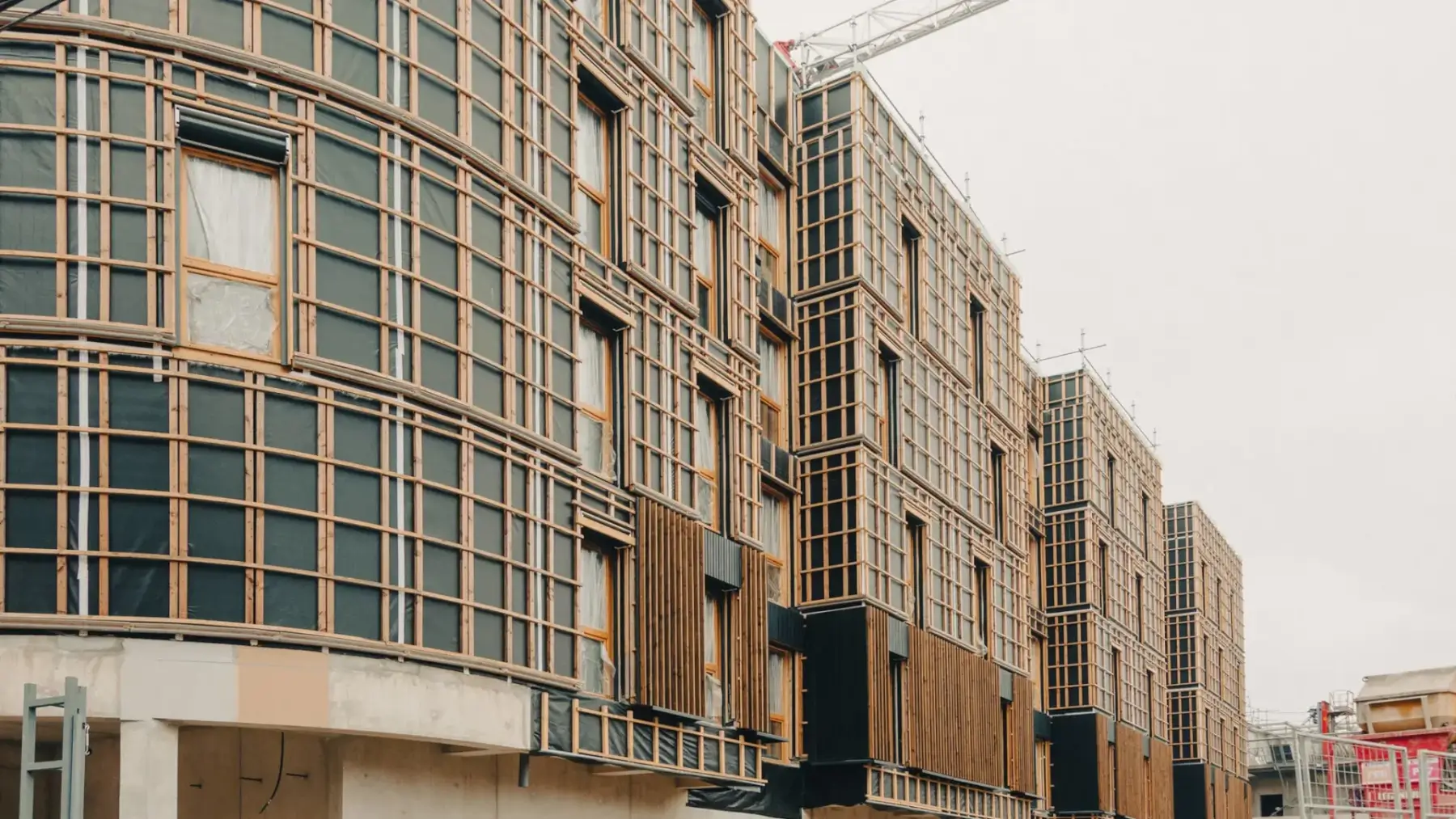
For the 2024 Paris Olympics, Pichet Group and Legendre Immobilier created sustainable buildings with a low carbon footprint in L’Île-Saint-Denis, an eco-district located north of Paris city centre. Metsä Wood’s long-term partner ISB Group was the Kerto LVL supplier for this project.
These buildings initially served as accommodations for Olympic athletes during the games and will be repurposed into residential apartments.
The Athletes’ Village was a showcase of sustainable hybrid construction, with 45% of the buildings using wood as the main material. The structural design of the wood-based buildings from the initial sketches to the final delivery was done by a timber construction expert Gustave.
Luc Boyer, partner of Gustave, explains: “These kinds of wooden structures have many technical and regulatory challenges, and they need to be carefully integrated. We had to manage several aspects including the details of building tall structures from wood, using pre-fabricated elements, creating flexible apartment layouts, and ensuring fire safety. We also had to consider sound insulation and maintaining thermal performance. All of this had to be done according to France’s intricate set of rules and regulations.”
Despite these constraints, the construction process was designed to be fast and efficient.
“We chose the best construction methods to achieve this exceptional project in record time,” says Thomas Charmasson, President of Gipen-Roux, which constructed the buildings.
Creating a heritage
Île-Saint-Denis was built to accommodate up to 2,700 athletes and officials, as well as providing offices, storage spaces and meeting rooms for the Olympics.
In 2025 the ‘Heritage’ phase will commence, transforming the area into a lively city district with residential apartments, businesses, shops, and public amenities.
The project is working towards the sustainability goals set by the City of Paris and Solideo, to help reach the climate plan’s target of no net carbon emissions by 2050 through effective carbon management. This shared commitment involves using eco-friendly materials and preparing the city for its 2050 sustainability goals.
To fulfil all the requirements of this large-scale construction project, prefabricated wooden elements were used. Offsite-manufactured elements have several advantages over traditional on-site construction; prefabricated elements help to optimise and minimise the logistics and delivery of materials to the construction site, while also reducing carbon emissions from transport and reducing time on site.
Efficient element manufacturing
Metsä Wood’s Kerto-Ripa technology is a timber construction system that uses Kerto LVL (laminated veneer lumber) products to create prefabricated load-bearing floor and roof elements.
Kerto Ripa elements consist of Kerto S-beams and Kerto Q-panels to form hollow box-shaped or T-shaped structures. These elements can be insulated, fire-protected and finished according to the client’s specifications. The technology offers several structural advantages for the contractor, such as high strength, lightness, fast installation, reduced material consumption, long spans and design flexibility.
Kerto LVL products are particularly suitable for prefabricated elements because they are lightweight, strong, offer large panel sizes (widths up to 2.4m and lengths up to 20m) and can carry heavy loads.
Available in a variety of thicknesses, widths and lengths, it is possible to choose the correct product size for every application to optimise material usage. The structure and properties of Kerto LVL make it extremely material-efficient and less volume is needed compared to other wood materials. In fact, this project was initially planned to be carried out using CLT, but the material was changed to LVL because of its properties.
Kerto-Ripa elements were selected for three different construction projects in Athletes’ Village. A total of 73 apartments and 3,828m2 of floor area were built with Kerto-Ripa box elements using only 268m3 of Kerto LVL. This means that the average use of Kerto LVL was only 0.07m3/2, underlining the material’s efficiency.
Successful cooperation
Gustave’s design office carried out BIM modelling for the project to streamline communications between the different stakeholders and, for example, to estimate the amount of needed volume of Kerto LVL.
Guillet Production, the manufacturer of the Kerto–Ripa elements, could complete the assembly of all elements within the prescribed deadlines, without overstocking the material. Thus, the right quantities of materials per produced area were ordered and delivered. The success was achieved due to excellent coordination between various stakeholders, including the producer Guillet and the ISB Groupe, Kerto LVL’s French supplier.
This was made possible by anticipating needs, ensuring the supply of Kerto LVL during a pandemic and wood shortage period, and leveraging the production capacity of Metsä Wood. As a result of good and efficient element design and prefabrication, Gipen-Roux was able to install the building elements in record time.
Benjamin Bodet, Managing Director of ISB Group, says: “The strong connection between Metsa Wood and Groupe ISB empowers us to offer smart solutions for significant projects using Kerto LVL. To seamlessly incorporate this exceptional wood product into projects, a comprehensive approach to service is vital. ISB addresses aspects like supply control, storage capacity, logistical expertise, and personalised machining—all geared towards easing wood systems construction and fostering the rapid development of Kerto LVL.”
* This article was originally published in the November/December 2024 issue of TDUK’s Supplying Timber magazine.