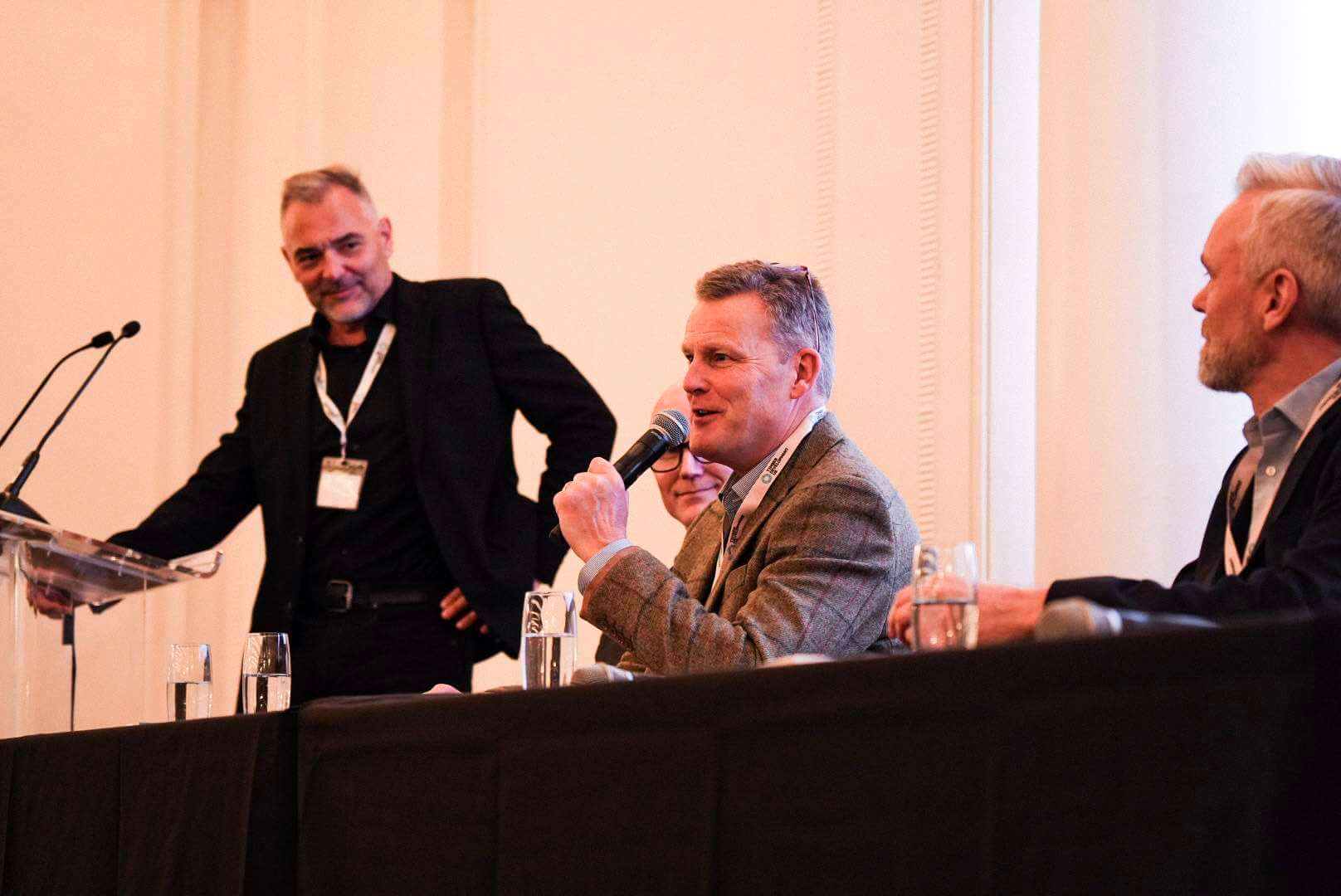
The UK Challenges in the Softwood Sector panel at this year’s Global Market Conference brought together senior figures from some of Europe’s largest sawmilling groups to discuss supply, demand and market expectations for 2026. Hosted by Timber Development UK (TDUK) Chief Executive David Hopkins, the panel featured Markus Henningsson of SCA, Neil Horton of BSW Timber, and Kalle Parviainen of Metsä Fibre.
The conversation opened with David asking how the UK’s homegrown sawmillers were faring compared with the broader international picture outlined by Markus earlier in the day. Representing BSW, Neil Horton said the domestic market had been “challenging, to say the least”, with weaker demand and heavy competition affecting margins. “The UK sawmilling industry is very much a reflection of our distributors and merchant customers”, he said. “We are dedicated to supplying our timber to the UK market, so when demand is flat, we feel it immediately.”
Neil explained that optimism at the very start of 2025 had since been tempered by slower construction output. “We came into the year cautiously optimistic,” he said. “The government was championing 300,000 new homes a year, but that hasn’t materialised.”
He noted that RMI activity has been equally subdued: “We’ve gone from forecasts of 3-4% growth to what looks like a flat year. The RMI market is absolutely critical for homegrown producers, and it just hasn’t lifted.”
Still, he pointed to areas of resilience. “The year started with appallingly bad weather, but for our sector, that can actually help. Storm damage drives demand for fencing and landscaping, and that’s given us an elongated season.” Looking ahead, he warned that the forthcoming Budget remained a key uncertainty but believed UK producers still had an opportunity to grow their market share.
Neil also highlighted the new campaign between leading businesses BSW Timber, Glennon Brothers and James Jones & Sons, who are working with Timber Development UK and Confor to promote C16-graded homegrown timber. “Three arch-rivals have come together to champion the use of British timber,” he said. “C16 is perfectly suited to the vast majority of applications, yet architects often specify C24 by default. That simple action can add unnecessary cost and exclude UK producers from the supply chain. We want to change that.”
David Hopkins then invited Kalle Parviainen of Metsä Fibre to describe the market conditions in Finland. “The demand has not been great in any of our markets globally,” Kalle said, “but it has been more a question of supply-demand balance.” He explained that raw-wood prices had reached near-record highs across Europe while log availability remained tight. “Many sawmills, including us, were able to push up prices in the middle of the year, but there wasn’t really demand there backing up the increases,” he said. “That lasted only for the first half, and I see this being the case for next year as well.”
Kalle said the Finnish industry had seen a period when “high log costs and weaker demand, especially from China”, had created what he called “a very toxic combination” for profitability. He added that the sector was “looking for a new balance between volume and prices”, and that would likely define the start of 2026.
When asked if sawmills in Finland were also curtailing production, Kalle replied that output figures were broadly stable. “Right now, we don’t really see curtailments,” he said, though he noted “availability is becoming an issue.”
Audience questions then turned to currency fluctuations. Markus acknowledged that the weaker Swedish krona had hit margins. “Currency effects have taken down profitability in the Swedish sawmill industry, together with record-high log prices,” he said.
Another attendee asked whether more volumes might be diverted from the UK into Germany as German mills reduced production. Markus was cautious: “I don’t think volumes will move from the UK to Germany. It’s rather that many other markets will have less volume available.”
Neil was also asked whether C16 could replace stronger grades such as TR26 used in trussed rafters. He said that while “C16 is not suitable for trusses,” it has real potential in structural timber frame. “Right now, the share of homegrown to imported timber in that sector is tiny,” he said. “It represents a phenomenal opportunity for us.”
Markus was later asked about the ongoing increase in pine, or redwood, production in Sweden. “Yes, that trend will continue,” he said. “It’s not dramatic, but the share of redwood will keep increasing slightly. It has already started and will continue.”
The panel also explored how long it takes for curtailed sawmills to restart production once demand returns. Kalle noted that many Finnish mills had used the profitable pandemic years to invest in upgraded capacity. “The capacity is there,” he said. “The question is raw material availability.”
Across the discussion, all three panellists agreed that 2025 had been marked by weak demand, cost pressure and volatile currency movements, yet the tone remained pragmatic. Neil summed it up: “It’s been a challenging year, but there’s cause to be optimistic. We’re working together to build the market for homegrown timber, and that’s something genuinely positive.”
Markus echoed that sentiment, suggesting that structural adjustments in species mix and production levels were part of a necessary transition. “It’s not that we don’t have Spruce any longer,” he said, “but yes, Redwood will continue to increase.”
The message from the panel was clear: despite economic headwinds, collaboration, cost discipline and product innovation remain key to stabilising the UK softwood market and preparing for a gradual recovery in 2026.