As regulatory expectations increase and supply chains face greater scrutiny, timber companies are under pressure to demonstrate that harvest origin claims are robust.
Documentation, certification and supplier engagement remain central to due diligence systems. But increasingly, companies are exploring scientific tools to add an additional layer of verification. One of the most established of these is chemical testing, mainly via stable isotope ratio analysis.
In conversation with TDUK, Victor Deklerck, Director of Science at World Forest ID, explains how chemical testing is moving from a niche forensic tool to a practical supply chain safeguard.
As Victor puts it, stable isotope analysis is now:
“The main scientific technique used to answer harvest origin questions in timber supply chains.”
For companies looking to strengthen compliance and protect supply chain integrity, understanding how and where this tool adds value is becoming increasingly relevant. Especially for companies operating in higher-risk geographies or managing complex supply chain networks.
Determination and Verification
Chemical testing can be used in two ways.
The first is determination – attempting to identify where in the world a wood sample was harvested.
The second is verification – assessing whether a declared harvest origin is plausible.
“For determination, the signal will not always be strong enough to clearly identify a small area,” Victor explains. “That’s where verification comes in – asking whether it could plausibly come from the declared harvest plot.”
For many companies, verification is the more practical application. If a business holds GPS data, shapefiles or clearly defined harvest regions, chemical testing can compare that information against reference datasets built from samples collected at known locations.
The purpose is not to replace documentation but to test whether it stands up to independent analysis.
Birch Supply Chains: A Real-World Example
In a recent timber market study focused on birch supply chains, World Forest ID applied origin verification testing to samples shared by manufacturers and retailers.
The organisation had previously developed a substantial birch reference collection, initially used by regulators investigating suspected sanctioned materials. When industry samples were tested against that dataset, 41% were found to have origin claims that did not align with testing results.
The study also included birch samples certified by FSC and PEFC. Of these certified products, 46% had incorrect origin or species claims. These findings demonstrate that certification schemes may not fully mitigate the risk of misdeclaring origins and can benefit from additional, science-based verification.
While the figures are striking, the outcome also demonstrated the value of testing as a risk management tool. Participating companies continued follow-up testing and strengthened internal controls as a result.
The study highlighted that certification alone may not always detect discrepancies, but that scientific testing can support continuous improvement.
Where Testing Adds Value
Chemical testing is generally most straightforward earlier in the supply chain, when wood is less processed, and the chemical signal is clearer. However, it can also be applied to finished products.
In practice, testing is typically integrated into a risk-based due diligence framework, targeting higher-risk species, geographies or trade routes rather than being applied universally.
Victor emphasises that testing works best when it complements existing systems rather than operating in isolation:
“The first step is just understanding how testing works and how it can be slotted into existing due diligence systems.”
Used thoughtfully, chemical testing strengthens procurement, compliance and risk management processes.
The Importance of Reference Data
The reliability of origin verification depends on the strength of reference datasets.
“These databases are made up of samples with known, verified locations,” Victor explains. “Without widespread reference collections, we can’t confidently assess where a product has come from.”
Building those datasets requires consistent sampling protocols and secure chains of custody. Samples are collected using transparent, non-proprietary methods, meaning laboratories worldwide can replicate testing and reach consistent results – a critical factor in regulatory contexts.
“It starts in the collection phase,” Victor explains. “Every sample is collected in the same way, with a secure, documented chain of custody. That consistency is what makes the reference database scientifically robust.”
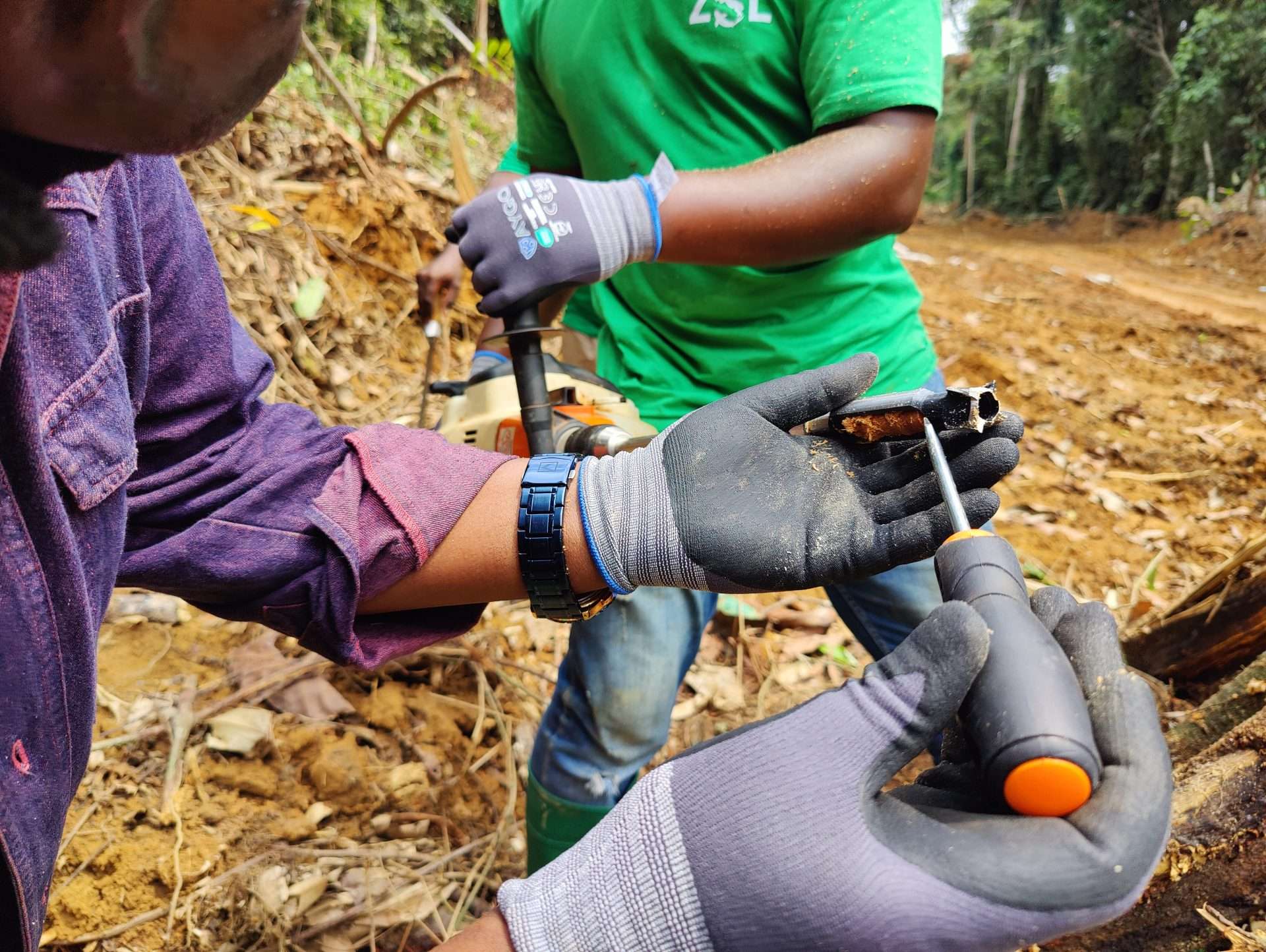
Ongoing fieldwork, including sample collection in Cameroon, continues to expand coverage for West and Central African species as part of broader global collections to strengthen origin models for industry use. This work forms part of a collaborative project by ZSL, World Forest ID, TDUK and Etifor to expand this database, specifically for widely traded timber species in Cameroon and the Republic of Congo. The project is funded by Fondation Lombard Odier and the European Union through the ECO-SOLVE project.
Looking Ahead
Testing capacity is expected to expand as more laboratories adopt standardised protocols, increasing speed and accessibility.
There is also growing integration of forensic approaches, including combining stable isotope ratio analysis with multi-element testing and environmental datasets such as satellite-derived land cover data.
At the same time, regulatory scrutiny continues to evolve. Scientific evidence is increasingly considered in enforcement contexts, and methodologies must withstand legal scrutiny.
Take Action
For timber companies seeking to strengthen harvest origin verification, chemical testing offers a practical, science-based addition to existing due diligence systems.
It does not replace certification or supplier engagement. But as transparency expectations rise, it provides an independent layer of assurance, helping protect reputation, manage risk, and support legal and sustainable trade.
If you are interested in exploring how chemical testing could strengthen your sourcing and due diligence systems, contact TDUK’s sustainability team to discuss practical next steps.