
Tom Coates
Tom Coates, Area Harvesting and Supply Manager for James Jones & Sons, gives his views on the forestry changes needed to make sure England has enough homegrown timber for the future.
The supporting document for the current Land Use Framework consultation doesn’t inspire much confidence that the wood we will use in future will come from England.
There is lots of positive messaging around the building of 1.5 million new homes and measures being introduced to address climate change, but there is little information about the benefits of using homegrown timber.
England has among the lowest forest cover in Europe, with a statutory commitment to reach 16.5% by 2050 (the current average in Europe is 38%). We import >80% of the wood we use and it’s difficult to understand why we don’t take timber security more seriously.
 The Land Use Framework’s supporting document makes no mention of the National Wood Strategy or the Timber in Construction (TiC) roadmap – while we may be a relatively small sector compared to others, surely we are an important one?
The TiC roadmap states that UK softwood availability will reduce in the next 25 years. Meanwhile, sawn wood supply would need to increase by 2-14% to meet the growing demand for timber. Thankfully, conifer trees are fast growing in the UK.
Nevertheless, the Land Use Framework consultation will hopefully provide an opportunity for anyone who sees the benefit in using wood to connect the dots for Government and bang the drum on how productive forestry can deliver on nature, climate change, economy and many other much-needed benefits.
An uphill battle
Reading more into the Department for Environment, Food and Rural Affairs Land Use Consultation’s supporting document, I think it’s quite clear that productive forestry in England has an uphill battle to fight. It’s not agriculture, and coniferous woodland is less favourable from a biodiversity perspective.
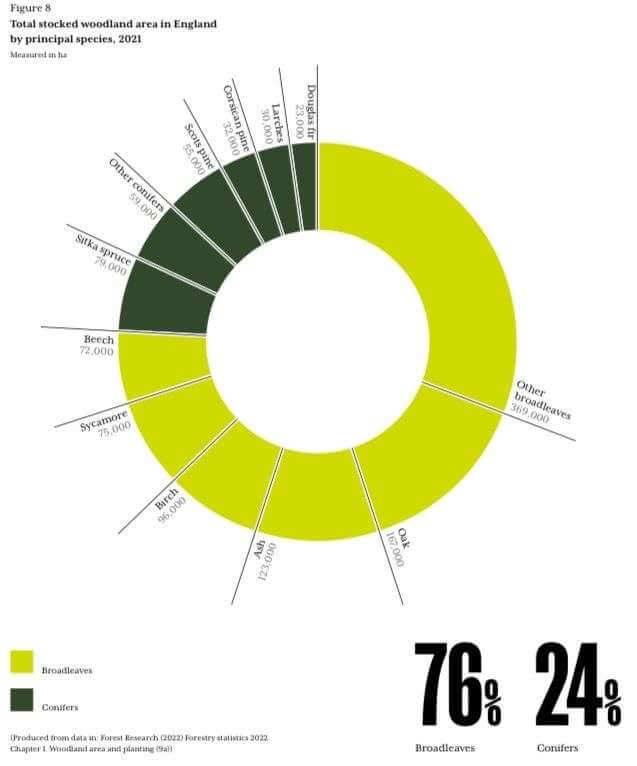
The new woodland creation figures in England are heavily tipped in favour of broadleaf species, compounded by the fact that areas of Conifer are decreasing due to restructuring and open habitat restoration (mostly for good reason), but it still means that timber-producing land is decreasing.
Meanwhile, the primary wood processing industry in the UK has invested more than £750 million in the past 15 years, according to Confor, and the north east of England is in the unique position of receiving the lion’s share of the investment in the next five years, including James Jones & Sons’ new state-of-the-art sawmill at Durham.
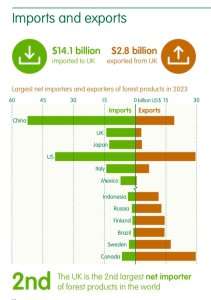
Considering the political turmoil across the world, will the Government start taking timber security more seriously, given the UK is currently the second largest net importer of wood in the world?
Don’t forget building with timber
What I find alarming is the disconnect between building houses and growing trees for timber. The Labour Government has committed to building 1.5 million new homes, and they have a huge opportunity to do this and deliver on net zero and climate change commitments simultaneously by using wood.
The TiC Roadmap shows the built environment accounts for 25% of greenhouse gas emissions in the UK, and using timber can reduce a building’s embodied emissions by 20-60%.
Construction-grade timber in the UK is, by and large, softwood. Therefore, if we want to use more homegrown timber in construction, we need to grow more conifer woodland.
It seems so obvious, but based on existing woodland management and new woodland creation, we don’t seem to be realising this.
What happens to all of the hardwood from the broadleaves we grow? Around 85% is burnt as wood fuel and many broadleaf woods are ravaged by squirrel and deer damage, rendering the sawn timber of poor quality.
The good news is that the Department for Environment, Food and Rural Affairs has committed to a policy that encourages building more with homegrown timber. In theory, does that mean we can move down the ranks of being the second-largest net importer of forest products?
I think it’s important that we realise that the UK is among the least forested nations in the world at 13% (Forest Research). The FAO put the European average forest cover at 38% and the countries we import most of our sawn timber from, such as Sweden (69% forest cover), Finland (75%) and Latvia (53%), have significant forest resources.
For context, this is important when we compare forest types, species diversity and silvicultural systems. We are asking a lot from the very little forest we have in the UK.
Do we have the land to increase forest cover? In theory, yes. The Forestry Commission have identified up to 3.2 million hectares of low sensitivity land that could be suitable for tree planting, and the National Food Strategy states that the least productive 20% of agricultural land in England produces only 3% of the calories consumed.
We now have a clear mandate from the UK Government to use more homegrown timber in construction. This is why it is so important for foresters and wood processors to respond to the Land Use Consultation and make sure their voices are heard.
* This article was originally published in the Spring 2025 issue of Supplying Timber magazine.