“When it comes to homegrown timber, it’s really important to talk about the fundamentals – so that designers understand what is generally possible, and how they can design with it,” says Tom Compton, Managing Director of English Woodlands Timber.
“With structural timber, strength is the concern. For exterior use, durability is the main factor. And for internal timber, it’s the visual grade that’s important.”
From their woodyard in West Sussex, English Woodlands Timber (EWT) supply high-quality timber for building works, furniture-making and joinery. A long-established merchant, they specialise in supplying and machining English and European timber. They have a huge range of UK timber species, including oak, elm, chestnut, ash, Douglas fir, larch and cedar in waney edge and square-edge profiles.
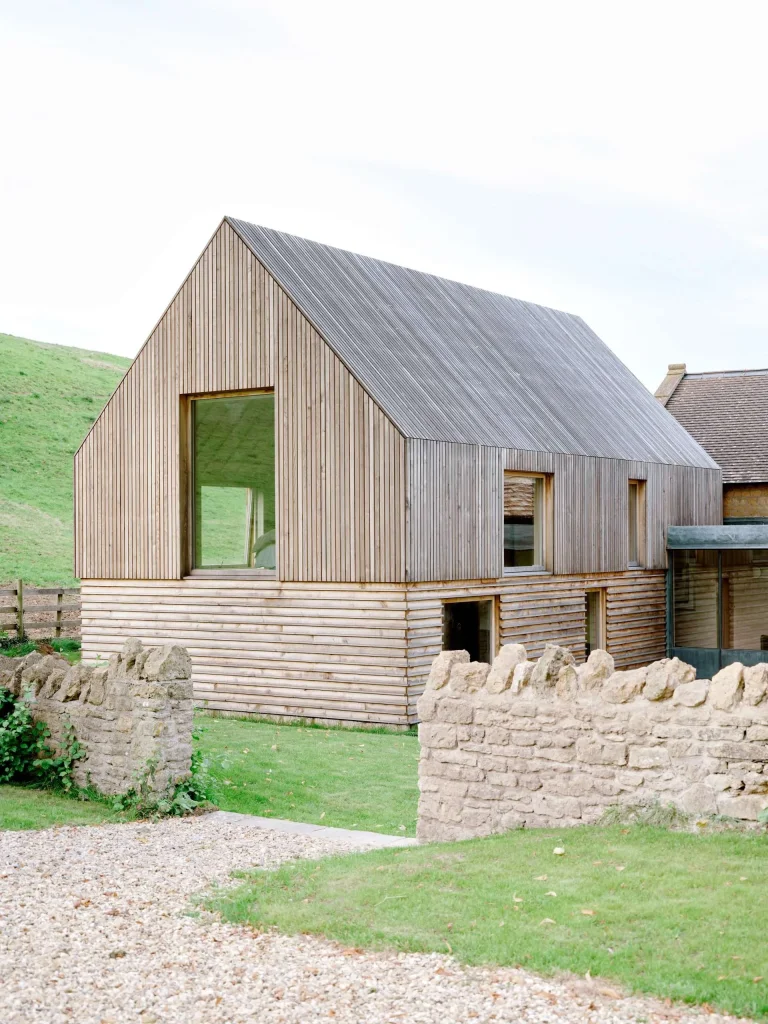
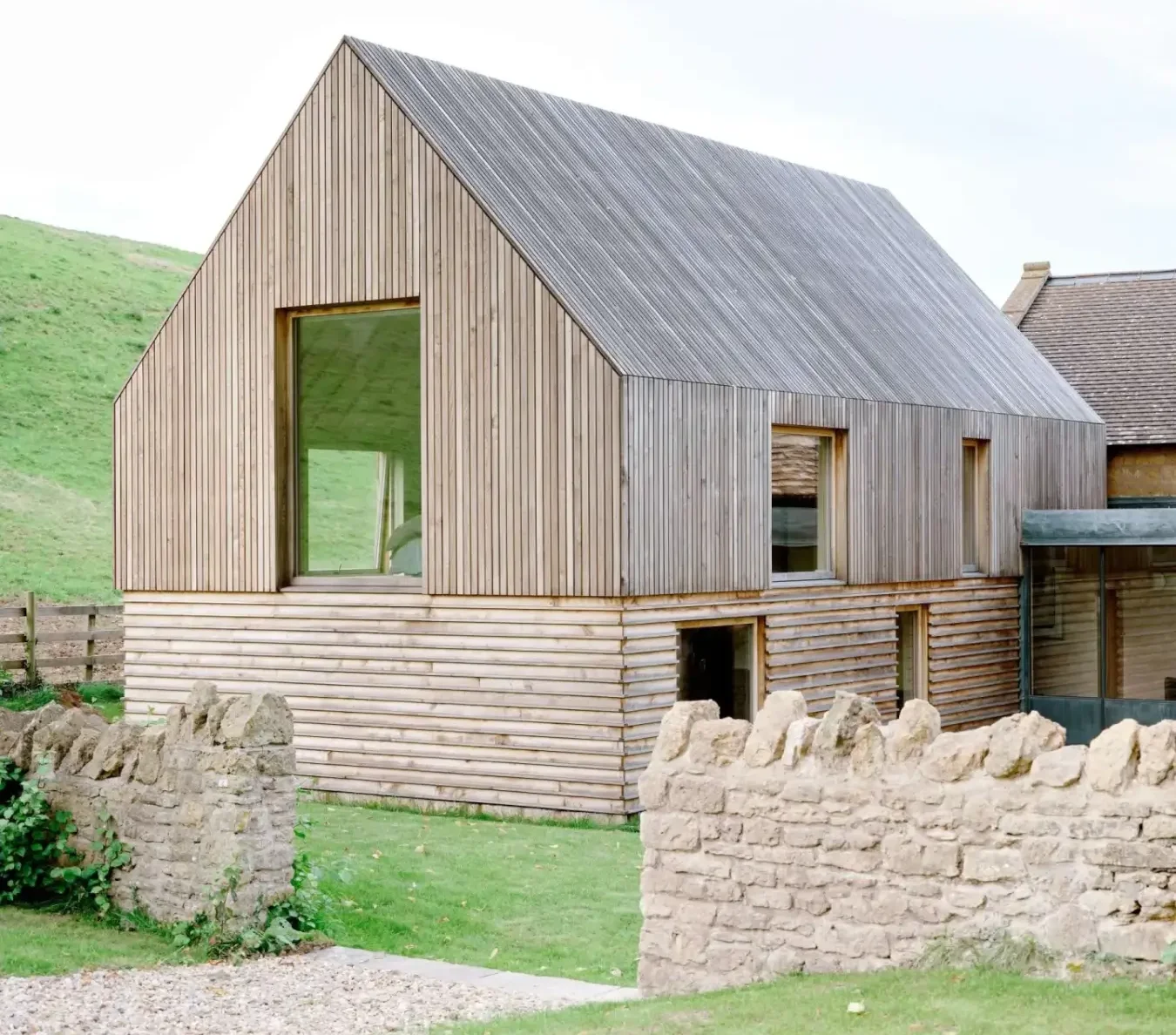
The Old School House, designed by Bindloss Dawes architects; © Francesca Iovene
Tom explains that EWT’s products fall into three main areas:
- The domestic trade: they supply builders with structural and cladding timbers.
- The joinery trade: they supply air-dried and kiln-dried timber, mainly oak.
- The bespoke furniture trade: they supply high-end, non-production-based businesses with unique pieces of wood with which they can craft beautiful interiors and furniture.
Timber for external cladding
Fresh-sawn oak and chestnut are two prominent naturally durable species that can be used for cladding. “As with structural oak, most of the oak used for cladding is French, but it’s perfectly possible to use English oak for cladding,” Tom says. “English oak tends to have more features to it; it doesn’t look as clean as French.”
“Chestnut is, for me, the gold standard in English hardwood for untreated or unmodified timber – used as an entirely natural product – but if you wanted a thermally treated wood for cladding then there are options such as Brimstone from Vastern Timber.”
When it comes to softwoods, homegrown Western Red Cedar and Douglas fir are good options for cladding – both are species originally from the west coast of America, but grown in the UK – and larch.
There are different durability classes of timber, and TDUK’s Timber Cladding Handbook – downloadable from the TDUK website – explains these in detail.
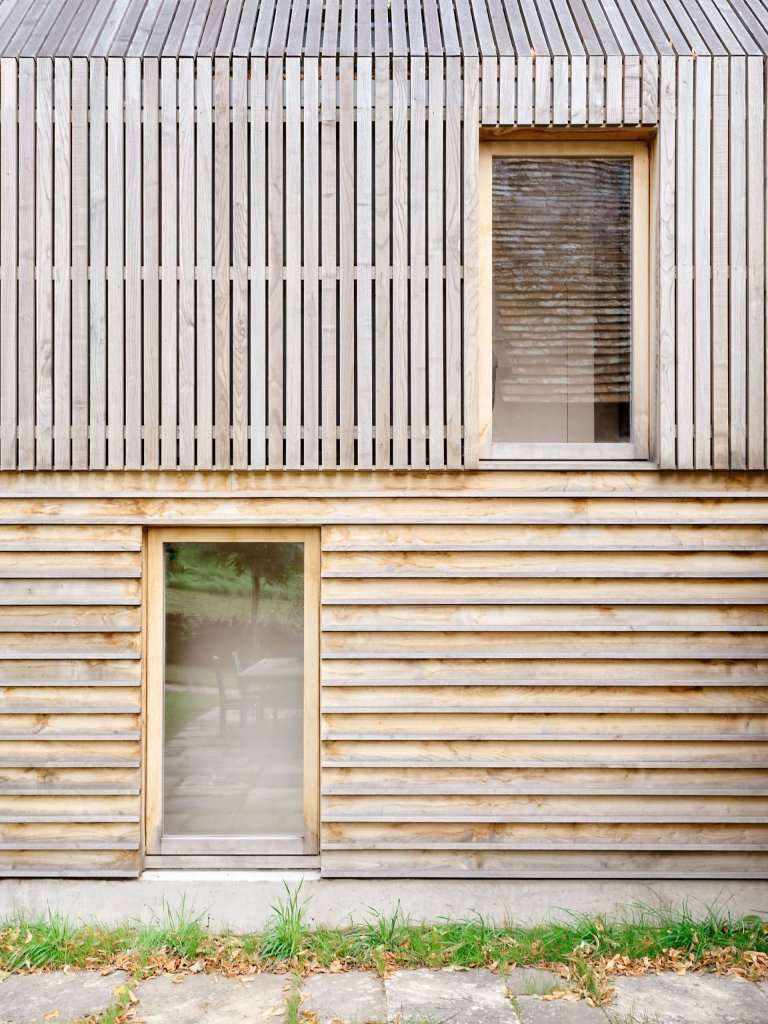
Close-up on the sweet chestnut cladding at the Old School House; © Francesca Iovene
“Class 3 is moderately durable, and that should provide a 25-year plus lifespan,” Tom says. “But critically, durability is highly dependent on the quality of fixings and how well cladding is installed.”
Excellent timber can be ruined by poor installation and, equally, a moderately durable timber will last a lot longer with careful design and fixing. “The ability of cladding to shed water is critical: if there are pockets where water gathers and can’t escape, then your durability will be effectively halved.”
Structural timber: oak and Douglas fir
In terms of structural timber, EWT supply almost entirely fresh-sawn oak and Douglas fir. Their structural oak is not typically from the UK, but from not much further afield: from France. “The French hardly build with any fresh-sawn oak themselves,” Tom tells us. “The majority of structural oak produced in France is exported to the UK.”
However, Tom points out that if you’re creating a frame in solid wood, you could design your structure using Douglas fir just as easily as oak.
“Some of the sections would have to be a little bigger because of the strength grading – so you have a bit more volume. But in terms of long sections and utility, Douglas fir is an underrated wood: it deserves to be seriously considered for structural elements.”
EWT will often quote customers the same cutting list in both oak and Douglas fir to give them the option; and Douglas fir will generally come out about 30% cheaper.
Joinery and furniture
For furniture and joinery, the wood species mix EWT offer is similar to cladding. The joinery wood EWT supplies is mainly oak, of which there is a mixture between French and English, and is subdivided into around half a dozen different feature grades. But they also provide ash, sweet chestnut, elm and walnut.
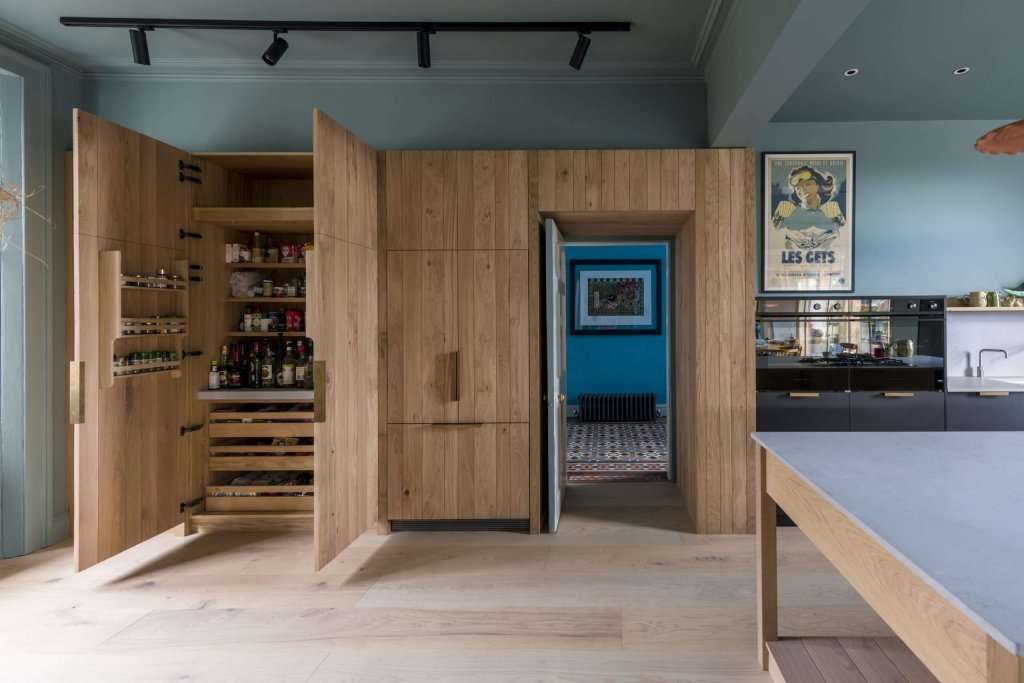
Kitchen designers Inglis Hall crafted a bespoke oak kitchen at the listed Renton Hall.
Elm is an interesting timber for furniture projects, and one which EWT is able to supply thanks to partnerships with forest managers in the north of England and the Scottish Borders. Elm has an interlocking grain which resists splitting, allowing joiners to craft pieces that can endure heavy use, such as tables, benches, and dressers, and it is perfect for mortise-and-tenon joinery. While elm’s grain can pose some machining challenges, it is a rewarding material to shape and finish: it is often used for carved details and unique forms.
Wood flooring
Solid oak flooring is EWT’s most popular unfinished hardwood flooring product. It has subtle, honeyed tones and a beautiful grain; it is cut from sustainably managed English woodland. It is characterful, as the grain is not always straight and even and has “pippy” characteristics which feature across the board. Its colour varies from paler to darker honey tones which are determined by the mineral content of the soil where the tree has grown.
Ash is a superb wood for using in a dark room, or a bedroom, where the aim is to bring brightness into a space. It’s extremely durable, with a beautiful grain and pale creamy tones. It seldom has any knots and can sometimes have a stunning contrasting darker grain running through the boards.
Perhaps the most visually striking of EWT’s English hardwoods is elm, which can create a stunning floor. The colour of elm solid wood flooring ranges from what could be described as dark purple to light green, with various hues of silver and brown in between. Extremely hardwearing, it does require care as the wood is sensitive to variations in moisture. In modern homes EWT recommend the use of English Wych Elm as it offers greater stability.
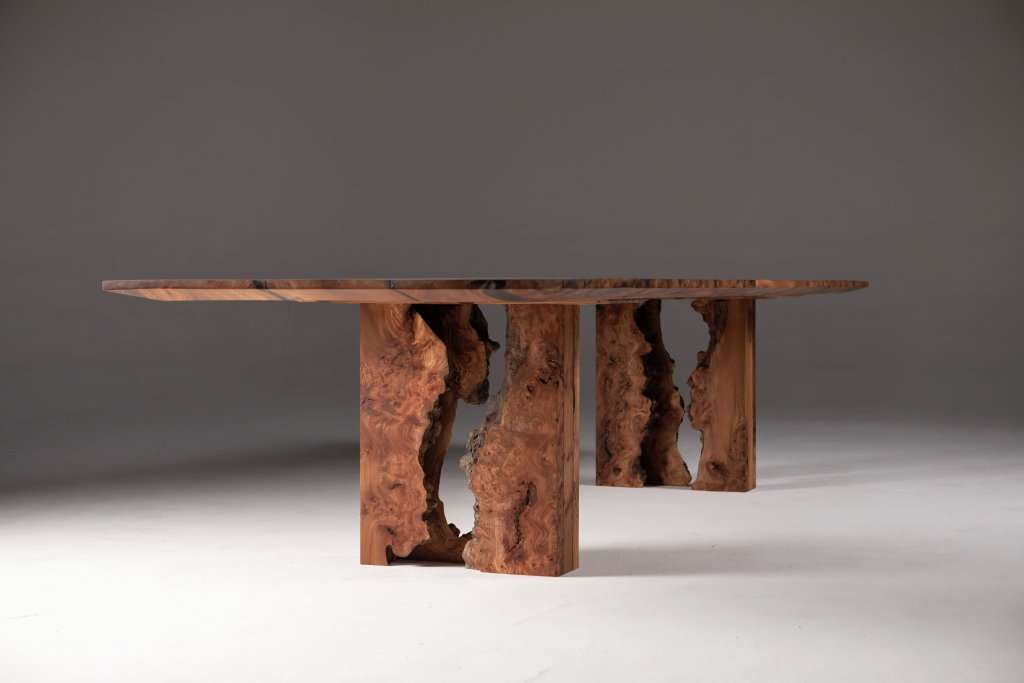
Bookmatched English elm table, by furniture maker Jonathan Field
Why use homegrown timber?
The distinctiveness – the different looks, textures and strengths – of UK timbers is one reason to use them. Another is that sourcing timber from the UK can reduce the carbon footprint of a project. Fewer miles of transport lessens emissions and can also minimize lead times. Furthermore, choosing homegrown timber is helping to sustain UK woodlands management, and the concomitant forestry jobs in rural communities.
“It all starts with the trees,” Tom says. “We have very engaged conversations with our customers because they understand that, by specifying British timber, they are helping the management of UK woods by providing a market for the product that’s grown in them.”
Designing with UK timber
“When you’re designing, as an architect, you need to understand the natural strengths and limitations of the raw material. With the sweet chestnut used for the cladding in the Old School House project, the particular challenge lay in sourcing long lengths in clean timber. If a designer is aware of that, they won’t draw, for example, an elevation with a five-metre solid length. It’s our job as an industry to communicate that.”
Working with the material, Tom suggests, is key to getting the best out of UK timber’s variety: exploring and embracing its variation. He points to the characterful interiors that UK timber species can create. “If you want a bland, regular, uniform look,” Tom says, “then English timber is probably not for you.”

Close-up of elm’s wild grain
Forest management
English Woodlands Forestry is a sister business to EWT. It manages some 20,000 acres of woodlands across southeast England, and helps their owners find markets. Its job is essentially to help owners bring to fruition long-term management plans to improve the vitality and productiveness of their woodlands.
“The woodland composition across our area is very varied, not least because we have a very mixed geology through the Weald: you can go from deep clay through greensand to chalk in ten miles. That encourages diverse tree species,” Tom tells us. “We’re blessed in our part of the world with a high percentage of woodland cover across the region. It’s about 20%, whereas the UK average is around 13%. We have Scots pine, spruce, Norway spruce, Western Red Cedar, Douglas fir, larch, ash and oak – often all in the same woodland.”
This makes management a lot more challenging than it would be for, say, an all-Sitka spruce plantation.
“Our job is to help owners with long-term planning – a big part of that is bringing round timber to market. A Scots pine tree can be broken down into three different markets. The bottom of the tree is for the log market and will be used for constructional timber. The middle part of the tree could be used for smaller sections or, increasingly commonly, it will be shaved to produce horse bedding. And then finally, there is the biomass or chipwood market.”
As managers, English Woodlands Forestry find the right market for a timber product in the most efficient way and return money to the owners, who can then reinvest it in the planting and biodiversity management.
“It’s a holistic management of the woodlands – of which timber is one output. But there are other important ecological outputs: biodiversity, water filtering through to our aquifers and carbon sequestration – so there are multi-layered benefits.”
Knowing your wood and where it excels
There is experience and skill required to understand what can be used. Within the variety of grades within the woodlands, only a certain percentage of it will be suitable for milling.
“When milling ash recently, there were three logs that showed a feature called ripple,” Tom recalls. “We know that musical instrument makers love ripple figure: it’s what they like in their end product. Being able to apply collective knowledge to find uses for naturally occurring qualities is one of the things that makes hardwoods fascinating.”
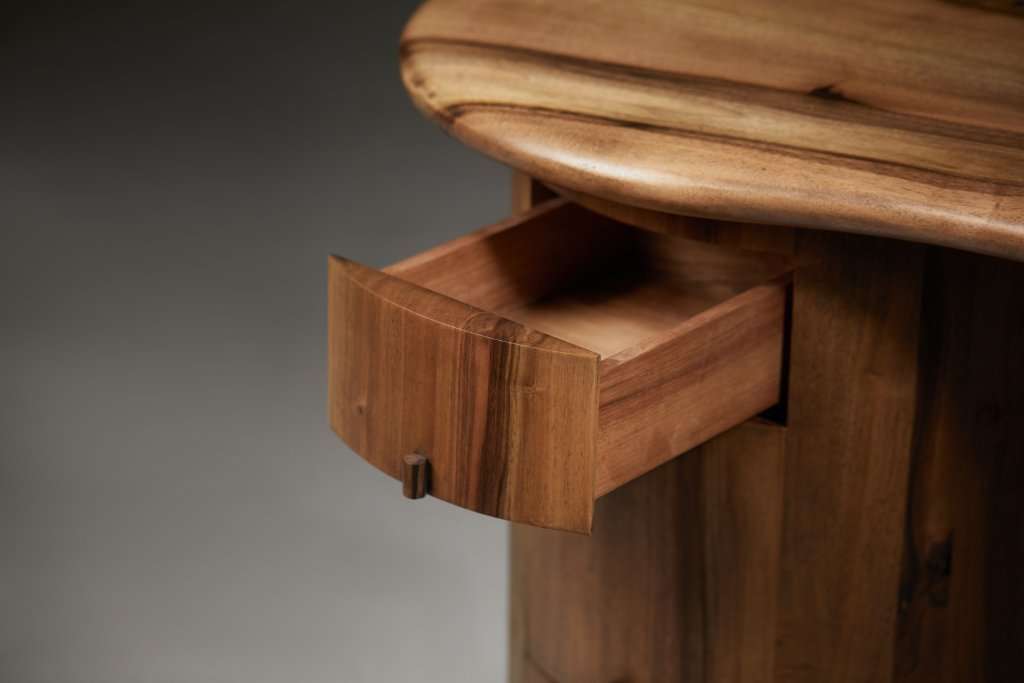
Detail showing drawer from English walnut table, made by Jonathan Field
A reliable supply chain
In terms of procurement, it’s of course important for a specifier to know that there is an established, dependable supply chain for homegrown timber. For its part, EWT has recently expanded, bringing Ben Sutton (Timber) Ltd into their fold. Ben Sutton (Timber) Ltd is a highly respected name in the hardwood and timber flooring industry, and this move adds a wealth of expertise in high-quality hardwoods and specialist timber flooring to EWT. Sutton Timber has already relocated from Sotterley Estate, Suffolk, to a new warehouse facility in Darsham, Suffolk, where all stock is now on hand and easily accessible.
Certified and sustainable
EWT are proud holders of both Grown in Britain (GiB) and PEFC chain-of-custody certification. That means whether the timber is sourced from a nearby estate in Sussex or a European forest under strict sustainability controls, it’s certified legal and sustainable. Each year, independent audits validate the strength of the company’s provenance systems. Grown in Britain certification has recently been given equal status alongside FSC and PEFC by the UK government.. It requires traceability of the wood products through a third-party process – providing reassurance to the customer of the timber’s provenance.
Bringing wood home
“When we first started, we were basically a shed on the side of a hill,” Tom recalls. “We wanted to make this mysterious timber accessible and visible, and we are happy to welcome people in so they can select their timber in person. You get a better conversation and therefore a better relationship with your customer that way.”
“I really enjoy meeting with a customer on the shop floor, and being able to serve them some wood that I found in a particular place. There’s a little bit of romance and magic to the English supply chain: we can connect people right back to the source, and that is our USP for many of our customers. That is a powerful connection.”
This article appears in issue 10 of Designing Timber magazine